GW Nursing clinical hours, program by program
Every GW nurse practitioner track requires 600 precepted clinical hours, whether you are in the MSN, the post-BSN DNP or a post-master's certificate. Midwifery, leadership and the DNP run to other totals, and a few of GW's own pages still print different numbers. Pick your track in the planner below, then read on for the totals side by side and the rules that decide whether an hour counts.
Get your placement plan
Tell us your GW program and where you live. A placement advisor replies with the preceptor and site options that fit your GW course.
Pick your GW program
Your clinical courses and hours, who can precept you, where, and when to start looking. From GW's own Bulletin and program pages.
- Who precepts
- An NP, MD, DO or CNM with two or more years in advanced practice (GW's 2021 guide), approved by your program director
- Where
- Internal medicine first, then OB/GYN and pediatrics, then family practice (GW's 2021 guide)
- Start looking
- A year out if you can: requests are due about four months before the term, and many sites book a year ahead
- Who precepts
- An NP, MD, DO or CNM with two or more years in advanced practice, approved by your program director
- Where
- Adult and adolescent primary care, then older-adult and long-term care hours in the third course (GW's 2021 guide)
- Start looking
- Before NURS 6222 ends; certificate students search as soon as they are admitted
- Who precepts
- An acute care preceptor, with GW's program director closely involved in choosing the placement
- Where
- Hospital medicine, then critical care (GW's 2021 guide), in DC, Maryland or Northern Virginia
- Start looking
- Talk with the program early; you must live in the area while taking NURS 6235 to NURS 6237
- Who precepts
- Psychiatric providers; NURS 6248 needs a PMHNP or psychiatric CNS preceptor (GW's 2021 guide)
- Where
- Outpatient and inpatient psychiatric settings across the lifespan, near where you live
- Start looking
- Certificate students start clinicals in their first course, NURS 6245
- Who precepts
- A seasoned midwifery preceptor, with GW's midwifery faculty and placement team supporting the search
- Where
- Birth centers, home birth and hospital practices, in the DC area or across the country
- Start looking
- Well before semester 7, when CLASI opens the immersion
- Who precepts
- A preceptor with a master's degree or higher; a different preceptor and site for the second practicum
- Where
- A leadership setting you and your instructor agree on (hospital, clinic, health system, public health)
- Start looking
- Before the capstone courses begin; plan both practicums at once
- Who precepts
- Your NP track's clinical preceptors for the 600 direct hours; the DNP project courses carry the rest
- Where
- The same clinical settings as the MSN track, in year three of the part-time plan
- Start looking
- Most post-BSN DNP plans put the first clinical course in semester 9 (PMHNP: semester 7)
Start with the planner, then use this page
The planner just under the page header walks through one GW program family at a time: its clinical courses in order, the hours attached to each, the kind of preceptor GW expects and a sensible time to begin looking. Choose your track there first and keep the course numbers handy.
This page covers what a single tab cannot. It sets the program totals next to each other, shows where GW Nursing's website, the GW Bulletin and older GW documents give different figures, and explains which hours GW accepts. Two sources carry the most weight: the Bulletin 2026-27, which is GW's newest official catalog, and the program pages on nursing.gwu.edu, which give the hours course by course.
Each topic here also has its own guide in this cluster, linked where it comes up, so you can go as deep as your question needs.
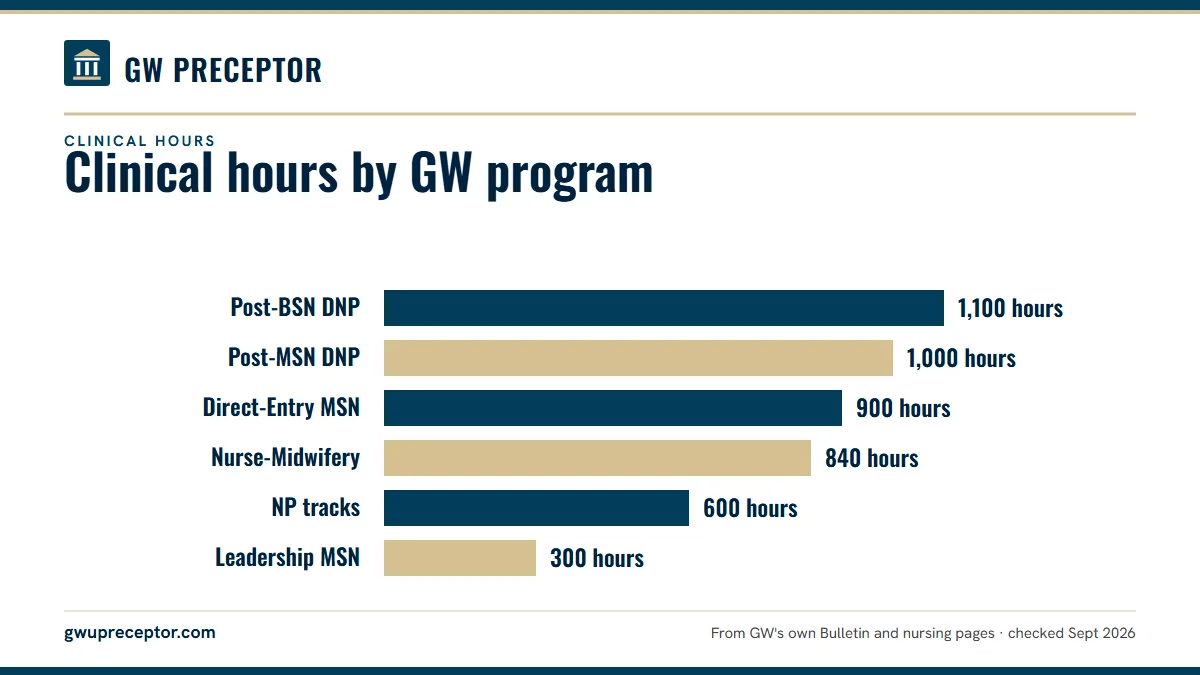
Hours by GW program
The table lists the precepted or practice hours GW publishes for each program with a clinical component, plus the course split wherever GW gives one. The two pre-licensure programs in Ashburn are included for completeness; GW's program staff arrange those placements.
| Program | Hours | How GW splits them |
|---|---|---|
| FNP (MSN and post-BSN DNP) | 600 | NURS 6230 120, NURS 6231 240, NURS 6232 240 |
| AGPCNP (MSN, DNP, certificate) | 600 | NURS 6224 120, NURS 6225 240, NURS 6229 240 |
| AGACNP (MSN, DNP, certificate) | 600 | NURS 6235 120, NURS 6236 240, NURS 6237 240 |
| PMHNP (MSN, DNP, certificate) | 600 | NURS 6244 through NURS 6248, 120 each |
| FNP post-master's certificate (not admitting) | 600 or 500 | Bulletin says 600, the web page says 500; practicum course NURS 6227 |
| Nurse-Midwifery MSN | 840 | Two immersion courses, NURS 6321 and NURS 6322; split not published |
| Nursing Leadership and Management MSN and MSN/MPH | 300 | NURS 6258 150, NURS 6259 150 with a different preceptor and site |
| Post-BSN DNP, all four NP tracks | 600 direct + 500 indirect | Direct hours follow the MSN clinical courses; indirect hours sit in the DNP project courses |
| Post-MSN DNP | 1,000 | 500 carried in from the MSN, 500 completed inside the DNP |
| Accelerated and Veterans BSN | 540 | Arranged by GW program staff |
| Direct-Entry MSN (Ashburn) | 900 | Per-course split not published |
The NP course splits, and the older figures still visible on a few GW pages, are unpacked in how GW reaches 600 hours.
Where GW's own figures disagree
Three conflicts come up often enough to plan around. None of them loosens the requirement; each one means you should confirm the number that applies to your entering class before you build a schedule on it.
- Post-BSN DNP. The Bulletin 2026-27 sets 600 direct clinical hours plus 500 indirect DNP practice hours. GW Nursing's DNP pages describe a minimum of 1,100 post-baccalaureate practice hours. The 2025-26 Bulletin gave 500 direct plus 500 indirect for the FNP, AGPCNP and AGACNP tracks. The full comparison is on the DNP practice hours page.
- FNP certificate. Its web page says 500 hours, while the 2025-26 and 2026-27 Bulletins both say 600. The certificate is not admitting, so this mostly affects students already enrolled.
- Legacy certificate text. Older text blocks still embedded on some certificate pages carry 625 hours for AGPCNP and 650 for AGACNP, the latter split 150/250/250, next to the current 600.
When two GW sources disagree, your program director and the Clinical Placement Team settle which one governs, and your course syllabus sets the target for each term. Ask by email so the answer stays on record.
What makes an hour count
GW accepts hours worked with an approved preceptor, at a site you have been cleared for, inside the dates of the term you are enrolled in. GW's 2026 CORE workshop told students to begin hours at the start of the term after clearance and no sooner. GW's 2021 clinical placement guide adds that hours logged without the proper license, or while a clearance is revoked, do not count.
Your running total is built shift by shift in CORE, GW's clinical system, as timesheet hours paired with patient encounter logs. The current rule asks for at least one patient logged per clinical hour, so a 240-hour course implies at least 240 logged encounters. How to enter both is covered on the clinical hour logs page.
A shift worked before your clearance notification, or outside the semester dates, is a compliance problem rather than a head start. GW's rule is clearance first, then hours from the start of the term.
Hours in a term: the 120 and 240 pattern
The NP tracks load their hours unevenly. The first clinical course carries 120 hours and the next two carry 240 each, so your second and third clinical terms need twice the clinic time of the first. PMHNP spreads its 600 hours across five 120-hour courses instead, although the part-time plans pair NURS 6244 with NURS 6246 in the same spring term.
GW publishes no maximum number of clinical hours per week, so the preceptor's own schedule usually sets your pace. A 240-hour course needs a preceptor with steady clinic days across the whole term; ask about their weekly pattern before the request goes into CORE.
Which settings suit each course comes from GW's 2021 clinical placement guide, summarized in rotation settings by course. The term in which your first 120-hour course lands depends on your plan of study; see your first clinical semester.
Evaluations, grades and hours that fall short
Hours are only part of what a clinical course grades. Your preceptor completes a mid-semester and a final evaluation sent through CORE, and a faculty member usually visits your site during your second or final clinical course. Both are explained in preceptor evaluations and site visits.
GW graduate courses need a grade of B or better. If a term is running out and your hours are short because a site fell through, speak with your Clinical Experience Faculty and program director early; GW's 2021 guide tells students with no site by mid-semester to do exactly that. What a failed or incomplete clinical course means for your progression is on the grades and clinical course failure page.
Why GW students trust us with their hours
Every number on this page rests on one thing GW leaves to most graduate students: a preceptor who agrees, at a site GW can clear, for the full length of the course. That search is our specialty. We look where you live for preceptors whose practice matches your GW course, confirm they can carry the hours your term demands, and assemble the license, bio or CV and site details your Site Prospector submission needs.
Your program director still signs off on every placement. Our part is making sure the file they review is complete and fits the course on the first pass. If a preceptor steps away mid-term, we start on a replacement at once so your hour count keeps climbing. Send your program and first clinical term through the contact form.
Questions GW students ask
Do CLASI or OSCE sessions count toward GW's 600 clinical hours?
GW ties the 600 hours to clinical experience with an approved preceptor, and it lists CLASI, the OSCEs and the end-of-program skills assessment as separate on-campus requirements. Treat those events as additions to your precepted hours rather than substitutes, and check your syllabus if a course describes its simulation work differently.
How many clinical hours does GW's PMHNP program require?
600, in the MSN, the post-BSN DNP and the post-master's certificate alike. They come in five courses of 120 hours each, NURS 6244 through NURS 6248. The Bulletin's description of NURS 6245 states the 120-hour minimum directly, and certificate students begin their rotations with that course.
Is the 840-hour midwifery total done with a preceptor?
Yes. GW describes two semesters of clinical immersion, 840 hours in total, completed with a seasoned preceptor after the didactic courses. The midwifery faculty and the Clinical Placement Team support students in securing sites in their own area, and GW's midwife network places particular emphasis on birth centers and home birth.
How are the Nursing Leadership and Management practicum hours split?
Into two courses of 150 hours each. NURS 6258 pairs you with a preceptor who holds a master's degree or higher, and NURS 6259 must use a different preceptor and a different site from the first practicum. The MSN/MPH dual degree follows the same pattern with a public-health focus in the first course.
Where can I see how many hours I have logged so far?
In CORE, where your timesheets and patient logs are stored for each rotation. Enter totals after every shift so the record stays current. If a number looks wrong, raise it with your Clinical Experience Faculty during the term rather than after it closes, since every hour has to fall inside the semester dates.
Related pages
Last checked 2026-09-24
We check these pages against GW's Bulletin and GW Nursing's own program and clinical pages. Your course, CORE and GW's Clinical Placement Team have the final word.
GW asks you to find your own site and preceptor. Hand that search to us.
Tell us your GW program, where you live and which clinical course is next. We find preceptors who fit the course and prepare the license, bio and site details GW's review asks for, so your Site Prospector goes in complete.
- Preceptors matched to the course: family practice for
NURS 6230toNURS 6232, older-adult primary care for AGPCNP, psychiatric care for PMHNP - License, bio or CV and the site's agreement signatory ready for your CORE submission
- Close to home, in DC, Maryland, Virginia or wherever you live and hold your RN license
Start your placement plan
Your program, city and next clinical term is all we need to begin.