GW's FNP clinical courses: NURS 6230, 6231 and 6232
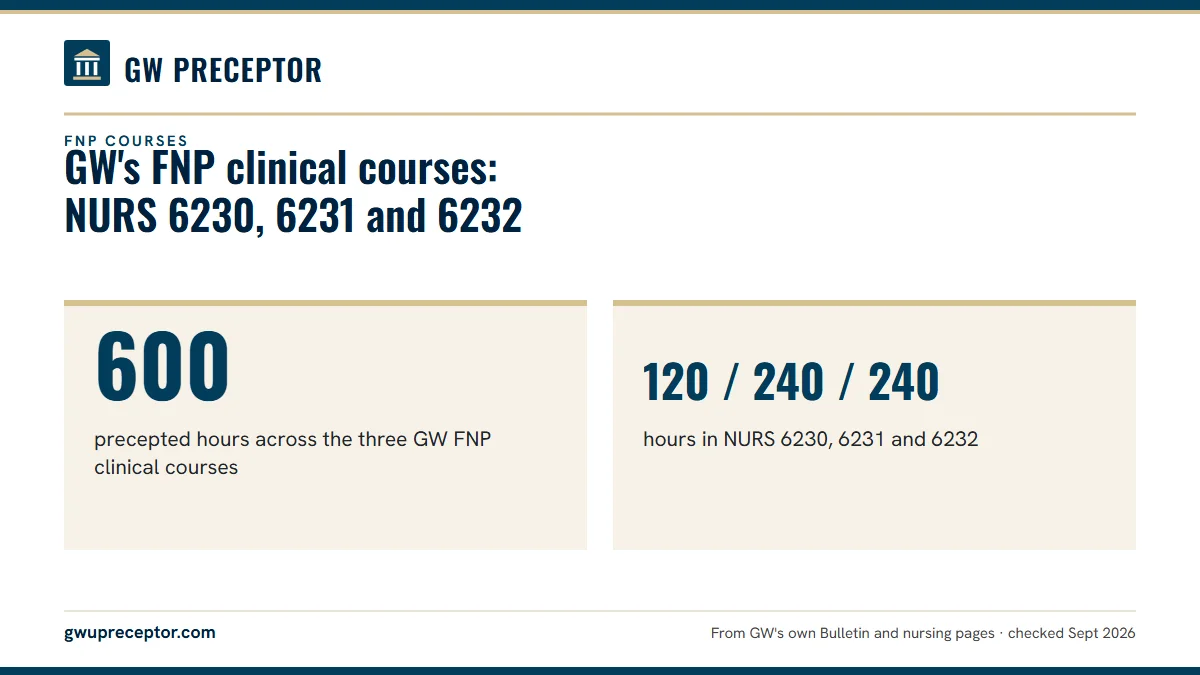
GW's Family Nurse Practitioner tracks place 600 precepted hours in three courses: 120 in NURS 6230, followed by two 240-hour courses, NURS 6231 and NURS 6232. Each course asks for a different kind of practice, moving from adult internal medicine to women's health and pediatrics to full family practice, so most FNP students need more than one preceptor. Here is what each course calls for and how to line it up.
Get your placement plan
Tell us your GW program and where you live. A placement advisor replies with the preceptor and site options that fit your GW course.
The three FNP courses at a glance
| Course | Title | Credits | Hours | Setting in GW's 2021 guide |
|---|---|---|---|---|
NURS 6230 | Family Nurse Practitioner I: Lifespan Primary Care/Diagnosis/Management | 4 | 120 | Internal medicine, no pediatric patients |
NURS 6231 | Family Nurse Practitioner II: Lifespan Primary Care/Diagnosis/Management | 8 | 240 | OB/GYN, about 60 OB and 60 GYN hours, plus pediatrics |
NURS 6232 | Family Nurse Practitioner III: Professional Issues/Diagnosis/Management | 8 | 240 | Family practice; a single specialty site capped at 50 hours |
The setting column is drawn from GW's 2021 clinical placement guide, a document still on GW's servers even though no current page points to it. Current syllabi may differ, so confirm the setting with your Clinical Experience Faculty before you commit to a preceptor.
The post-BSN DNP FNP track uses the same three courses and the same hours. The FNP post-master's certificate used a different set, NURS 6227 alongside NURS 6250, NURS 6251 and NURS 6252, and is not admitting new students.
NURS 6230: adult internal medicine first
Your first FNP rotation is 120 hours, roughly fifteen eight-hour days, and GW's 2021 guide places it in internal medicine with no pediatric patients. The course title says lifespan, yet the guide keeps this first term on adults, which lets you build history, exam and diagnostic habits on one population before children arrive.
The natural preceptor is an internist, MD or DO, or a nurse practitioner working in an adult internal medicine or adult primary care office. GW's 2021 guide asks every preceptor to be an NP, MD, DO or CNM with two or more years of advanced practice behind them and an unencumbered license that is current; the preceptor requirements page covers the full rule.
A family practice can work only if your hours stay with adult patients, and many family clinics mix ages on every schedule. Ask your Clinical Experience Faculty before you build 6230 around a family office.
NURS 6231: women's health and pediatrics in one term
NURS 6231 doubles the load to 240 hours and splits it across two very different populations. GW's 2021 guide describes about 60 obstetric hours and 60 gynecologic hours, plus pediatrics. If your syllabus follows that split, about half the course is left for children.
That usually means two or three preceptors in one semester: an OB/GYN physician, a certified nurse-midwife or a women's health NP for the OB and GYN hours, and a pediatrician or an NP who sees children for the rest. A CNM appears on GW's accepted credential list, which makes a midwifery practice a strong fit for the obstetric hours.
Each preceptor at each site needs its own Site Prospector submission for the term, so a split course means several filings, each with its own license and bio or CV. The Site Prospector guide explains the rule. This is also the course that brings OSCE 1, covered in the OSCE guide.
NURS 6231 is the course FNP students most often under-plan. Start the OB, GYN and pediatric searches at the same time, not one after another.
NURS 6232: full family practice, with room for one specialty
The final 240 hours return you to primary care across the lifespan. GW's 2021 guide places NURS 6232 in family practice and lets you spend as many as 50 hours at a single specialty site, which reads as an option rather than a requirement.
The best preceptor here is a family nurse practitioner or a family medicine physician whose schedule mixes children, adults and older adults, since this course is where you pull the whole FNP role together. If you use the specialty allowance, pick a clinic that fills a gap in your logs and clear it with your Clinical Experience Faculty first.
OSCE 2 falls during this course for FNP students. GW's FNP certificate page also says a faculty site visit usually happens during the second or final clinical course, so expect faculty contact with your 6231 or 6232 site.
Three courses back to back: plan the pipeline
GW's FNP plans run the three courses in consecutive terms. A full-time fall starter runs them summer, fall and spring; a full-time spring starter runs them fall, spring and summer. Part-time plans and the post-BSN DNP start later but keep the same unbroken run. The first clinical semester guide has each plan.
Because GW wants each placement request about four months before its term, you file the request for the next course while you are still logging hours in the current one. By the time 6230 begins, the 6231 search should already be moving, and GW's own advice notes that many sites fill their calendars a year or more ahead.
NURS 6222 sits the semester before 6230, so the whole pipeline starts there. Treat the three courses as one project with three deadlines, not three separate searches.
Why FNP students choose us
We plan all three FNP courses at once. That means an adult internal medicine preceptor for 6230, OB, GYN and pediatric preceptors lined up together for 6231, and a family practice with a mixed panel for 6232, each matched to the setting GW's 2021 guide describes and each near where you live.
For every preceptor we collect the documents GW looks for in CORE: a current license, a CV or preceptor bio, who signs agreements for the practice, and why the site suits that course. Each Site Prospector entry goes in whole and on time; the sign-off belongs to GW's program director, who gets a tidy file to judge. When someone drops mid-sequence, finding the successor is our job. Learn how it works or begin with the contact form.
Questions GW students ask
Can one preceptor cover all of NURS 6231?
Only if one practice gives you obstetric, gynecologic and pediatric patients in the proportions your syllabus asks for, which is uncommon. GW's 2021 guide describes about 60 OB hours, 60 GYN hours and pediatrics in this course. Expect two or three preceptors, each filed as its own Site Prospector entry, and settle the plan with your Clinical Experience Faculty early.
Can a physician assistant precept me in the FNP courses?
The credential list in GW's 2021 clinical placement guide stops at four: nurse practitioner, MD, DO and certified nurse-midwife, each backed by two-plus years of advanced practice. Physician assistants are not on that list, and no current GW page adds them. Plan your FNP search around nurse practitioners, physicians and, for obstetric hours, certified nurse-midwives.
Do DNP FNP students take different clinical courses?
No. The post-BSN DNP FNP runs NURS 6230, NURS 6231 and NURS 6232 at identical hours. GW's November 2024 part-time DNP plan starts the first of them in the summer of year three. The DNP adds indirect practice hours through the DNP project courses, which GW counts separately from the precepted 600.
Is the 50-hour specialty site in NURS 6232 required?
GW's 2021 guide permits a specialty site in the third FNP course for no more than 50 hours, which reads as a ceiling, not a requirement. Keeping all 240 hours in family practice is a perfectly sound plan. If you want a specialty block, get your Clinical Experience Faculty's agreement first, and remember that site needs its own Site Prospector entry.
Where do the FNP OSCEs fall in 2026-27?
GW's NP dashboard sets FNP OSCE 1 for October 5–6, 2026 and OSCE 2 for the weekend of February 27–28, 2027, with Ross Hall in Foggy Bottom hosting both. They land during NURS 6231 and NURS 6232. Share the dates with your preceptors when you first meet so your hours stay on track.
Related pages
Last checked 2026-09-24
We check these pages against GW's Bulletin and GW Nursing's own program and clinical pages. Your course, CORE and GW's Clinical Placement Team have the final word.
GW asks you to find your own site and preceptor. Hand that search to us.
Tell us your GW program, where you live and which clinical course is next. We find preceptors who fit the course and prepare the license, bio and site details GW's review asks for, so your Site Prospector goes in complete.
- Preceptors matched to the course: family practice for
NURS 6230toNURS 6232, older-adult primary care for AGPCNP, psychiatric care for PMHNP - License, bio or CV and the site's agreement signatory ready for your CORE submission
- Close to home, in DC, Maryland, Virginia or wherever you live and hold your RN license
Start your placement plan
Your program, city and next clinical term is all we need to begin.