Preceptor evaluations and faculty site visits at GW
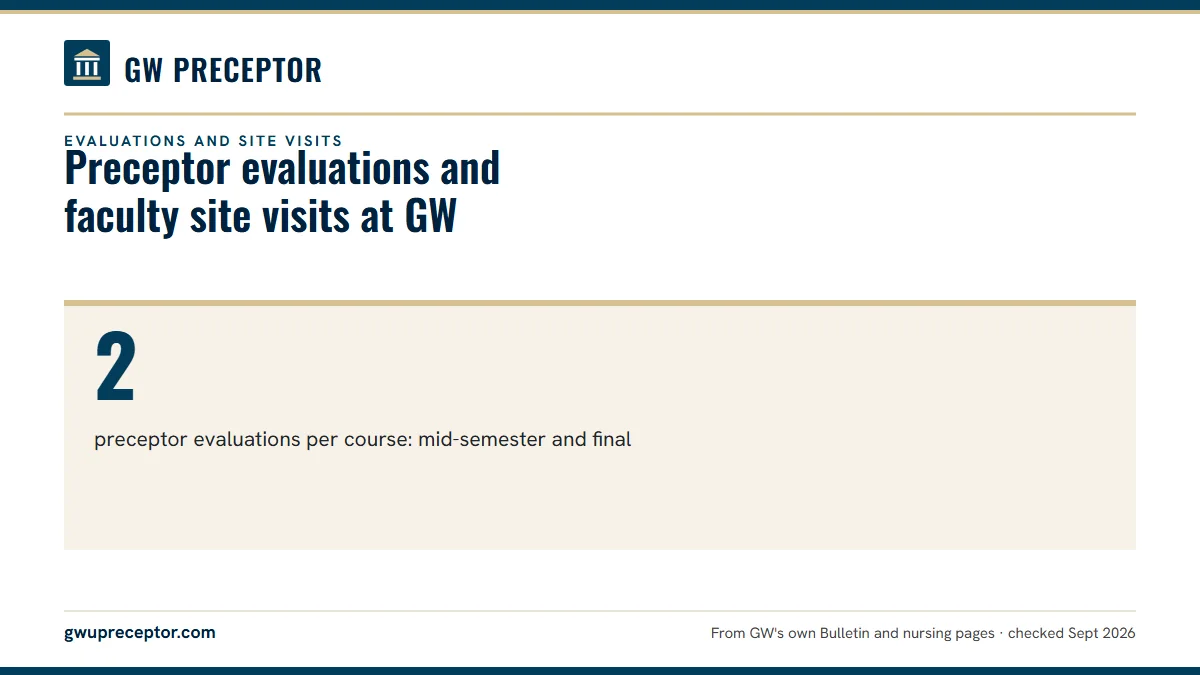
Your GW preceptor evaluates you twice in each clinical course, at mid-semester and at the end, on forms sent from CORE and talked through with you before they are submitted. Alongside the preceptor, a Clinical Experience Faculty member supervises your clinical work each term, and a faculty member usually visits your site during your second or final clinical course.
Get your placement plan
Tell us your GW program and where you live. A placement advisor replies with the preceptor and site options that fit your GW course.
Who judges your work in a GW clinical course
Several people have a say in how a clinical term goes. Your preceptor sees your work day to day and completes the formal evaluations. Your Clinical Experience Faculty, the CEF, supervises you in clinical for the term and judges whether the site and preceptor are appropriate. Course faculty review sites and preceptors against the course objectives.
Behind them stand the program director, who approved the placement to begin with, and the Clinical Placement Team, which cleared you to start and verifies any change of preceptor. How those roles fit across the whole placement process is set out on the Clinical Placement Team page.
Knowing who holds which piece matters most when something goes wrong mid-term, because each question has a natural owner and the right one can act fastest.
The two preceptor evaluations
GW's 2021 clinical placement guide describes a mid-semester and a final evaluation for each clinical course. Both are emailed to the preceptor from CORE. Each is to be "discussed with the student prior to its electronic submission," and once submitted it can be viewed in CORE. The conversation comes first and the form second, so nothing in a GW evaluation should arrive as a surprise.
The mid-semester evaluation is the one to use. It lands with half the term still ahead, so a comment about pace, documentation or patient load can still shape the final one. Ask your preceptor to walk through it with you, note what they want to see more of, and tell your CEF if the feedback suggests the site is not giving you what the course requires.
One detail trips students up: CORE sends the forms to the preceptor email given in your Site Prospector submission. GW's 2026 CORE workshop reminded students to enter the right address for preceptor evaluations, so check it against the inbox your preceptor actually reads.
Before any evaluation: the preceptor guide
The evaluations assume your preceptor knows what GW expects of them. GW's 2026 workshop told students to confirm that the preceptor has seen GW's preceptor guide, to have them sign its last page, and to upload that signed page to CORE themselves. The guide is not public, so the copy you pass on comes through your course or CORE. The bio form and sign-off are covered on the preceptor bio and guide page.
A preceptor who has read the guide understands the course level you are at, which makes both evaluations fairer. It also helps to share your course objectives and hour target on the first day, so the preceptor can plan the patient mix the course needs rather than discovering it at mid-semester.
Your Clinical Experience Faculty
GW's 2026 workshop describes the CEF in three parts: clinical supervision, guidance and mentorship for students in clinical; assignment before each term; and responsibility for whether the site and preceptor are appropriate. The CEF is the first person to tell when something at the site is not working, whether that is patient volume, the preceptor's availability or the kind of cases you are seeing.
GW's 2021 guide gives the CEF further jobs. The CEF helps students work out how to identify sites, and occupational exposures are reported to the CEF, who then informs the site, the program director and the clinical education lead the guide calls the Director of Graduate Clinical Education and Compliance. Medical costs from an exposure are the student's own responsibility under that guide. It also tells students with no site by mid-semester to meet the CEF and program director about whether the course objectives can still be met.
Faculty site visits: timing and format
GW's FNP certificate page gives the timing: "A clinical site visit will be conducted, usually during your second or final clinical course, by a faculty member." The same sentence survives in older text on the AGACNP and AGPCNP certificate pages, and an older block on the DNP PMHNP page says a faculty member may conduct a site visit. In 2017, GW described these visits as a way to evaluate students' progress.
GW does not publish whether a visit happens in person or virtually, how long it lasts, or what form the visitor uses. Your CEF or course faculty will tell you when yours is due and how it will run. Let your preceptor and the site's manager know early that a GW faculty member may visit or call, so the visit fits around the clinic's schedule.
Evaluations, OSCEs and your course grade
Preceptor evaluations are one input among several. NP students also sit OSCEs during their second clinical course, and every NP student completes an end-of-program skills assessment; both are described on the OSCEs and skills assessment page. GW graduate courses require a grade of B or better, and the consequences of a failed clinical course are on the grades and clinical course failure page.
If an evaluation raises a concern, answer it through your CEF while the term is still open. A complete record of hours and patients in CORE, plus a preceptor who knew the course objectives from the start, makes that conversation far easier; the logging rules are on the clinical hour logs page.
Why GW students choose us for preceptors ready to teach
A fair evaluation starts with a preceptor who is prepared to teach at your course level and has the time to do it. We match GW students with preceptors whose practice fits the course, brief them on what a GW rotation asks of them, and prepare the license, bio or CV and correct contact details your Site Prospector submission needs, so evaluation forms reach the right inbox.
We also make sure the preceptor knows a faculty visit may come, so it lands as a routine check rather than an interruption. If a preceptor steps away partway through, we line up a replacement fast; see when a preceptor drops out. Clinicians weighing a GW student can read precepting a GW student.
Questions GW students ask
Where do I find my completed preceptor evaluations?
In CORE. GW's 2021 guide says the mid-semester and final evaluations become visible there once the preceptor submits them. If a form has not appeared when you expect it, check that the preceptor received the email from CORE, then let your CEF know so the course record is complete before grades are due.
What if my preceptor has not completed the evaluation?
Start with the simple causes: the email may have gone to an old or wrong address, or into a filter. Confirm the address held in CORE, give your preceptor a polite reminder with the due date from your course, and tell your CEF early if the form is still outstanding as the term closes.
Does a faculty site visit mean something is wrong?
No. GW's program text treats the visit as a routine part of the clinical sequence, usually scheduled during the second or final clinical course, and GW has described such visits as a way to evaluate progress. Treat it as a chance to show your work and to raise any site concerns with faculty directly.
Can I change preceptors after a poor mid-semester evaluation?
GW's process allows a change of preceptor, but it is not instant. Discuss it with your CEF and program director first. Any new or added preceptor needs a CORE submission and verification by the Clinical Placement Team before you work with them, and all hours still have to fit inside the semester dates.
What does GW offer preceptors who complete these evaluations?
GW's Become a Preceptor page lists access to the Himmelfarb Health Sciences Library, the chance to guest lecture at GW Nursing in an area of expertise, and an invitation to collaborate with other preceptors. GW says over 200 preceptors are working one-to-one with its students this year.
Related pages
Last checked 2026-09-24
We check these pages against GW's Bulletin and GW Nursing's own program and clinical pages. Your course, CORE and GW's Clinical Placement Team have the final word.
GW asks you to find your own site and preceptor. Hand that search to us.
Tell us your GW program, where you live and which clinical course is next. We find preceptors who fit the course and prepare the license, bio and site details GW's review asks for, so your Site Prospector goes in complete.
- Preceptors matched to the course: family practice for
NURS 6230toNURS 6232, older-adult primary care for AGPCNP, psychiatric care for PMHNP - License, bio or CV and the site's agreement signatory ready for your CORE submission
- Close to home, in DC, Maryland, Virginia or wherever you live and hold your RN license
Start your placement plan
Your program, city and next clinical term is all we need to begin.