Logging your GW clinical hours in CORE
GW Nursing tracks every clinical hour in CORE, the same system that holds your placement requests and evaluations. Each shift produces two records: a timesheet entry with your total hours, and patient encounter logs with at least one patient for every hour you claim. Hours count only after clearance and only inside the semester dates.
Get your placement plan
Tell us your GW program and where you live. A placement advisor replies with the preceptor and site options that fit your GW course.
Two records for every shift
GW's Compliance and Clinical page describes CORE as the system GW Nursing uses for clinical requests and as the repository for tracking clinical hours and clinical documents. For hours, it keeps two kinds of record. The first is the timesheet, which answers how long you were at the site. The second is the field encounter, the patient or case log, which answers whom you saw.
Because GW sets its encounter rule per hour, the two records have to agree with each other. A long day with only a handful of patients will not meet the rule, however carefully the hours are entered. GW's 2021 clinical placement guide used the older names Timesheets and Patient Data Logs for the same pair, so you may see either wording in course materials.
The rest of CORE, from the Site Prospector form to the Document Library, is covered on the CORE ELMS page.
GW's logging rules, from the 2026 CORE workshop
GW's 2026 CORE workshop deck, shown to NP students at CLASI, gives four rules for hour logs. They are short enough to quote in full.
- "Document after each shift (if not weekly)." Log while the day is fresh; a week is the outer limit.
- "Make sure to enter TOTAL hours." Each timesheet entry should carry the full hours for that shift.
- "Minimum of 1 patient (field encounter/case log) PER hour." An eight-hour day needs at least eight encounters behind it.
- "All clinical hours must be completed WITHIN the semester dates." Time before the term opens or after it closes is outside the count.
The same deck told students they may start hours at the start of the term after clearance and no sooner. GW's 2021 guide adds that hours logged without the proper license, or during a clearance revocation, do not count. Clearance itself is explained on the clinical clearance page.
Logging a shift, step by step
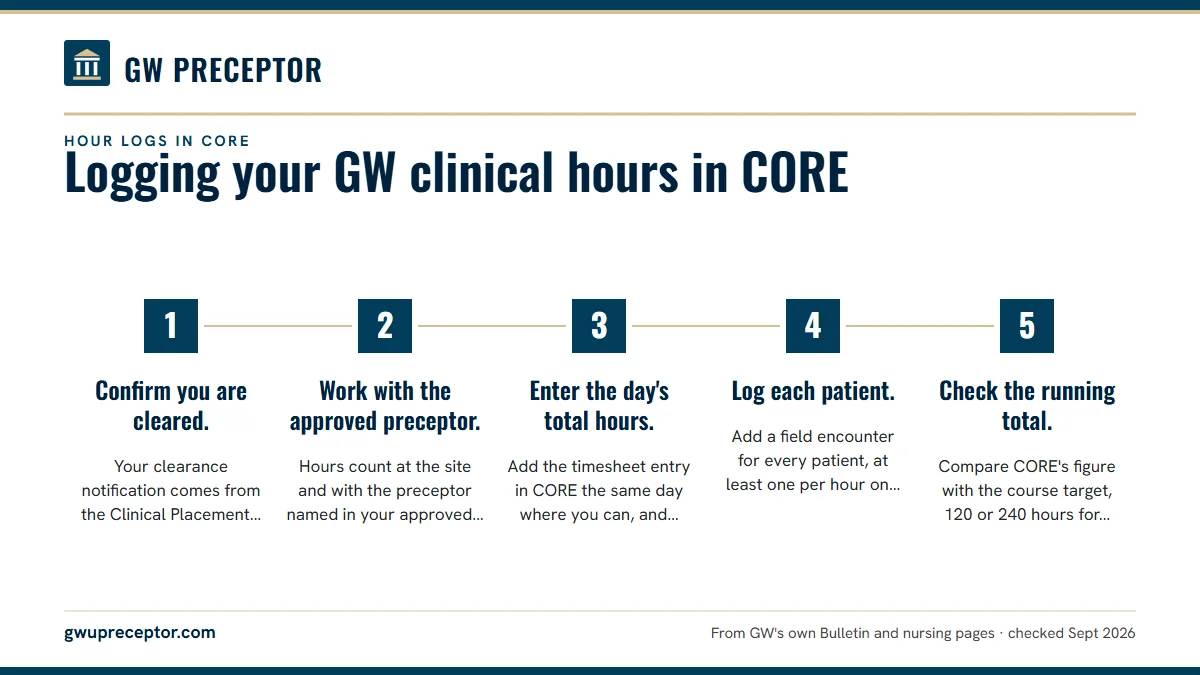
- Confirm you are cleared.Your clearance notification comes from the Clinical Placement Team before the term begins. No hour counts before it.
- Work with the approved preceptor.Hours count at the site and with the preceptor named in your approved request. GW's 2021 guide requires the Clinical Placement Team to verify any new or added preceptor before you work with them.
- Enter the day's total hours.Add the timesheet entry in CORE the same day where you can, and within the week at the latest.
- Log each patient.Add a field encounter for every patient, at least one per hour on the timesheet, keeping each entry within what your course and GW's HIPAA training allow.
- Check the running total.Compare CORE's figure with the course target, 120 or 240 hours for most NP courses, several weeks before the term ends.
Patient numbers: the 2021 targets and today's rule
GW's 2021 clinical placement guide set patient targets for the AGPCNP courses. For AGPCNP 1, NURS 6224, it gave 110 patients, which it framed as roughly six a day across eight-hour days. That target predates the per-hour rule and falls below it: at one patient per hour, a 120-hour course needs at least 120 encounters, or eight in an eight-hour day.
Follow the current rule and your course syllabus, which may add its own expectations about the mix of patients. Before CORE, GW used E*Value, and in 2016 FNP students needed 700 encounters across the program. That system and figure are history, but they show that GW has long judged clinical work by patients seen as well as hours spent. The per-course hour totals are on the 600 clinical hours page.
When a site's patient volume runs low
A preceptor with a light schedule can leave you with plenty of hours and too few encounters. Your Clinical Experience Faculty is assigned before each term to supervise you in clinical and to judge whether the site and preceptor suit the course, so a low-volume site is theirs to hear about early. GW's 2026 workshop told students directly to let the CEF know when a site or preceptor is not appropriate.
Adding a second preceptor is a route GW's process allows, since CORE takes a separate submission for each preceptor and site in a term. Build in time for that: the new preceptor still needs Clinical Placement Team verification before your hours with them count. If you are already behind, behind on clinical hours sets out the options.
The calendar is part of the log
Because every hour must fall inside the semester dates, the calendar shapes your log as much as the clinic does. A late clearance, a slow start at the site or a preceptor's vacation each remove weeks you cannot recover later. GW's 2026 workshop expected every student to have a site by the end of the second week, which leaves the rest of the term for 120 or 240 hours.
If the term is closing and your total is short, speak with your CEF and program director before the final week rather than after grades post. What an incomplete or withdrawal involves is covered in the semester calendar and incompletes. Your preceptor's evaluations also run through CORE; see preceptor evaluations and site visits.
Why GW students choose us before the first log entry
A clean log starts with the right placement: a preceptor with enough clinic days and a full enough schedule to meet GW's per-hour rule. We search for preceptors whose patient volume suits your course, check that their calendar can carry 120 or 240 hours inside the term, and prepare the documents your Site Prospector submission needs so clearance arrives on time.
If a site's volume drops or a preceptor leaves mid-term, we source a replacement quickly so your log keeps moving. Share your GW course and term through the form below, and your placement advisor will map the search around your semester dates. Every program's totals are side by side on clinical hours by program.
Questions GW students ask
Does my preceptor sign my hours in CORE?
GW's public material does not describe a preceptor sign-off on each timesheet. What it does describe is the preceptor signing the last page of the preceptor guide, which you upload to CORE, and the mid-semester and final evaluations CORE sends to the preceptor. Check your course for any timesheet approval step it adds.
Do I log clinical hours in CORE or in Complio?
CORE. Complio, run by American DataBank, holds your compliance items such as the background check, drug screen, immunizations, BLS and license. CORE holds the placement side: requests, timesheets, patient logs, documents and evaluations. Both have to be current, since incomplete compliance can hold up the clearance your hours depend on.
What happens to hours worked at a site before clearance?
They fall outside GW's count, because hours may begin only at the start of the term after clearance. GW's 2021 guide also warns that entering a clinical site before the Clinical Placement Team clears you can lead to dismissal, and that only that team, not faculty or the site, can give permission to start.
Is there a weekly maximum on GW clinical hours?
GW publishes no weekly maximum. The practical limits are the semester dates, your preceptor's schedule and your own work and course load. GW's DNP FNP page strongly recommends that students not work full-time, which gives a sense of the time the clinical terms demand.
Related pages
Last checked 2026-09-24
We check these pages against GW's Bulletin and GW Nursing's own program and clinical pages. Your course, CORE and GW's Clinical Placement Team have the final word.
GW asks you to find your own site and preceptor. Hand that search to us.
Tell us your GW program, where you live and which clinical course is next. We find preceptors who fit the course and prepare the license, bio and site details GW's review asks for, so your Site Prospector goes in complete.
- Preceptors matched to the course: family practice for
NURS 6230toNURS 6232, older-adult primary care for AGPCNP, psychiatric care for PMHNP - License, bio or CV and the site's agreement signatory ready for your CORE submission
- Close to home, in DC, Maryland, Virginia or wherever you live and hold your RN license
Start your placement plan
Your program, city and next clinical term is all we need to begin.