GW's Acute Care NP MSN: hospital clinicals in DC, Maryland and Northern Virginia
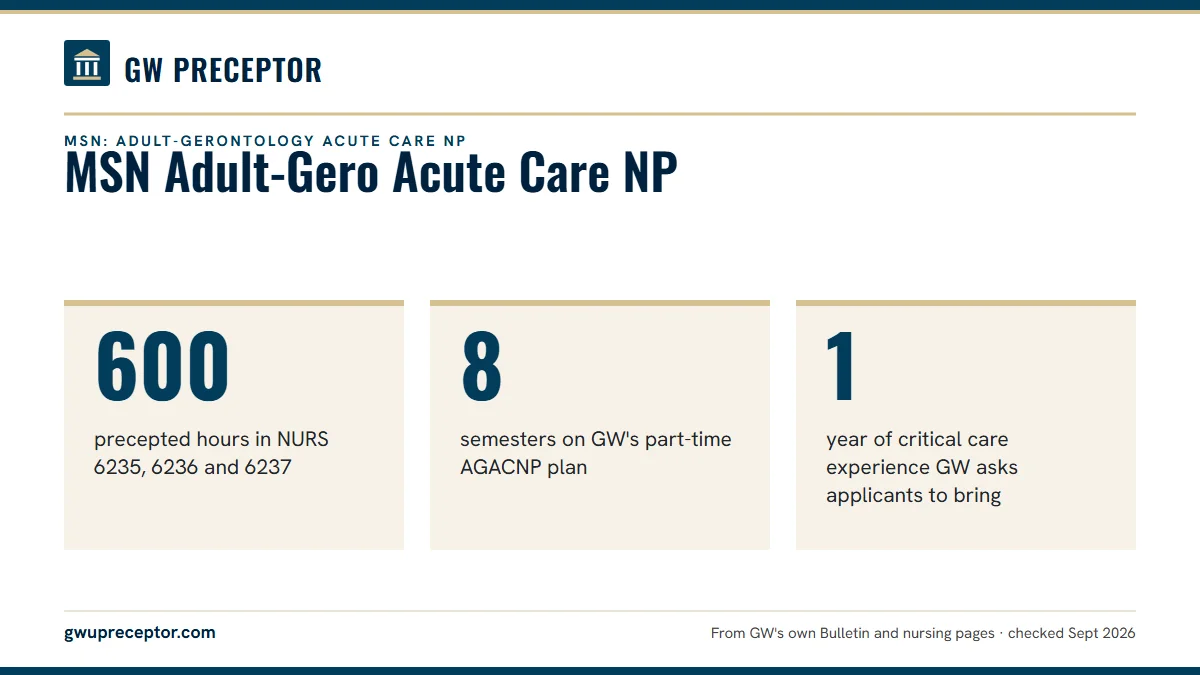
GW's Adult-Gerontology Acute Care NP MSN is the one NP track GW exempts from its find-your-own-preceptor rule. Clinicals stay in DC, Maryland or Northern Virginia, the program director is closely involved in choosing sites, and applicants must live in DC, Maryland or Virginia with a year of critical care behind them. The program runs part-time from a fall start, with 600 hours across three hospital-based courses.
Acute care preceptors near you
Tell us your county, your next AGACNP course and its term. Your placement advisor comes back with documented acute care options.
The AGACNP MSN at a glance
Acute care carries more entry conditions than any other GW NP track, and most of them trace back to where and how the clinicals run.
| Item | What GW publishes |
|---|---|
| Credits | 48 |
| Precepted clinical hours | 600 |
| Format | Online, with CLASI and on-campus AGACNP Clinical Simulation Events |
| Start term | Fall only |
| Pace | Part-time only, 8 semesters |
| First clinical | NURS 6235 in semester 6, the second summer |
| Residency | DC, Maryland or Virginia |
| Experience | At least one year in critical care (ICU, trauma, CCU or emergency department) within the past five years |
| Extra compliance item | Current ACLS from the American Heart Association or American Red Cross |
The credit load matches GW's other NP MSNs; what differs is who can enroll and where the hours happen. GW's State Authorizations page also closes every AGACNP option to applicants from Washington state.
Who arranges the placements: GW's sources side by side
Every GW source agrees on geography. They differ on who picks the site:
| GW source | What it says |
|---|---|
| Clinical Rotations page | Graduate students secure their own site and preceptor, except in the Acute Care NP program options |
| Bulletin 2026-27, MSN AGACNP | Placements are selected jointly by the student and the program director, in Northern Virginia, Maryland or DC |
| DNP AGACNP program page | The program director arranges placements in Northern Virginia, Maryland or DC |
| MSN AGACNP Clinical Placement tab | The standard line encouraging you to find your own preceptor, with local site information offered |
Read together, they describe a program director who is closely involved, with your input and your contacts still welcome. Ask the program director early how your cohort's placements will be set, and do it before you approach a hospital on your own. The fuller comparison lives on our AGACNP clinical placements page.
Speak with the AGACNP program director before you contact acute care sites yourself. GW's own pages describe that role in different ways.
Why residency and critical care matter for clinicals
The residency rule follows the clinicals. GW's MSN page requires applicants to be residents of the District of Columbia, Maryland or Virginia, and the Bulletin's DNP and certificate pages go further, requiring that students reside in Maryland, Northern Virginia or DC for the duration of the three clinical courses. A Virginia resident outside Northern Virginia meets the MSN wording but would still travel into the region for every shift.
The critical care year shows up on the unit. GW's 2021 clinical placement guide mapped it out: NURS 6235 in hospital medicine, telemetry or intermediate care; NURS 6236 in critical care, allowing up to 100 hours in a specialty; NURS 6237 back in critical care or in long-term care, rehab or geriatric units. The Bulletin names ICU, trauma, CCU and emergency department experience within five years; the web version asks for a year in a critical care setting. Confirm current settings on the rotation settings page and in each syllabus.
Three courses and the simulation events
Acute care students return to campus more often than any other NP track. CLASI comes first, during NURS 6222. Then GW brings you back for what it calls AGACNP Clinical Simulation Events during each of the three clinical courses, and the Bulletin speaks of several campus experiences built around coursework, skills development and patient assessment. Put those days into your hospital schedule from the start. Course detail: AGACNP clinical courses.
With NURS 6235, NURS 6236 and NURS 6237 falling in consecutive summer, fall and spring terms, placement work barely pauses. On GW's website the summer course's request is due around February 1, fall's around May 1 and spring's around October 1. Whatever part the program director plays in choosing sites, your Complio record, ACLS card and RN licenses need to be current for each of those starts.
| Course | Title (Bulletin 2026-27) | Credits | Hours | Term on the plan |
|---|---|---|---|---|
NURS 6235 | Adult-Gerontology Acute Care Nurse Practitioner I: Introduction to Practice | 4 | 120 | Year two, summer |
NURS 6236 | Adult-Gerontology Acute Care Nurse Practitioner II: Complex and Acute Illness | 8 | 240 | Year three, fall |
NURS 6237 | Adult-Gerontology Acute Care Nurse Practitioner III: Complex and Chronic Disease Mgt Adolesc/Elderly | 8 | 240 | Year three, spring |
Licenses and hospital requirements in the DC region
Rotating across the District and its neighbors raises a licensing question most online students never face. GW requires RN licensure in each jurisdiction you rotate in, and its 2026 CORE workshop suggested that students around Washington pair a multistate license from Maryland or Virginia with a separate DC license. If one term could take you to a hospital in DC and another in Maryland, plan for both. See RN licenses for clinicals.
Hospitals add their own onboarding too. GW's clearance rests on four things: a signed agreement with the site, the preceptor's paperwork, a finished Complio file (ACLS included for this track) and whatever the site or state adds. GW has posted system-specific screening pages for regional systems such as Inova, HCA and Virginia Hospital Center, a reminder that each system can ask for more than GW does.
How we help acute care students
With the program director closely involved, the strongest thing you can bring to that conversation is a ready, documented option. That is what we prepare. Your placement advisor finds hospitalists, intensivists and acute care NPs in DC, Maryland and Northern Virginia who fit the course you are entering, from hospital medicine and telemetry for NURS 6235 to critical care for NURS 6236, and confirms availability for the term.
We then assemble license and bio or CV for each preceptor, the hospital's agreement signatory and the course fit, so whatever you and the program director settle on can move straight into CORE. If a hospital preceptor steps away mid-term, we begin a replacement search at once. The program director has the final say on every acute care site; we bring options that are complete and inside GW's rules. Tell us your county and next course through the contact form, and read about Northern Virginia preceptors.
Questions GW students ask
Can I apply to GW's AGACNP MSN from outside DC, Maryland or Virginia?
Not under the current rules. The MSN page limits the program to residents of DC, Maryland or Virginia, GW's State Authorizations page excludes Washington state from every AGACNP option, and all rotations take place in DC, Maryland or Northern Virginia. If a move into the region is part of your plan, confirm the timing with admissions before you apply.
Does emergency department nursing count as critical care for AGACNP admission?
The Bulletin 2026-27 lists the emergency department alongside ICU, trauma and CCU, and asks for at least one year of that experience within the past five years. The program page uses the broader phrase "critical care setting." If your experience is mixed, part-time or older, ask admissions how they will count it before you apply.
Is there a full-time AGACNP MSN at GW?
GW posts only a part-time plan for the AGACNP MSN: eight semesters from a fall start, with NURS 6235 in the sixth. The program admits in fall only. GW's post-master's AGACNP certificate is shorter but requires an MSN already, and GW's sources give different lengths for it.
What compliance items are specific to acute care?
An ACLS card from the AHA or American Red Cross, on top of BLS and the rest of GW's Complio checklist. Complio should be purchased within four months of your first clinical day, and the ACLS card has to stay valid through all three clinical courses. The full checklist is on our Complio page.
Should I choose the AGACNP MSN or GW's acute care DNP?
Same three clinical courses, same 600 precepted hours, same DC, Maryland and Northern Virginia limit. The DNP runs 72 credits over 11 part-time semesters, reaches NURS 6235 in semester 9 and adds indirect DNP practice hours. DNP students, per the Bulletin, must reside in the region during their clinical courses.
Related pages
Last checked 2026-09-24
We check these pages against GW's Bulletin and GW Nursing's own program and clinical pages. Your course, CORE and GW's Clinical Placement Team have the final word.
GW asks you to find your own site and preceptor. Hand that search to us.
Tell us your GW program, where you live and which clinical course is next. We find preceptors who fit the course and prepare the license, bio and site details GW's review asks for, so your Site Prospector goes in complete.
- Preceptors matched to the course: family practice for
NURS 6230toNURS 6232, older-adult primary care for AGPCNP, psychiatric care for PMHNP - License, bio or CV and the site's agreement signatory ready for your CORE submission
- Close to home, in DC, Maryland, Virginia or wherever you live and hold your RN license
Start your placement plan
Your program, city and next clinical term is all we need to begin.