GW's AGACNP clinical courses: NURS 6235, 6236 and 6237
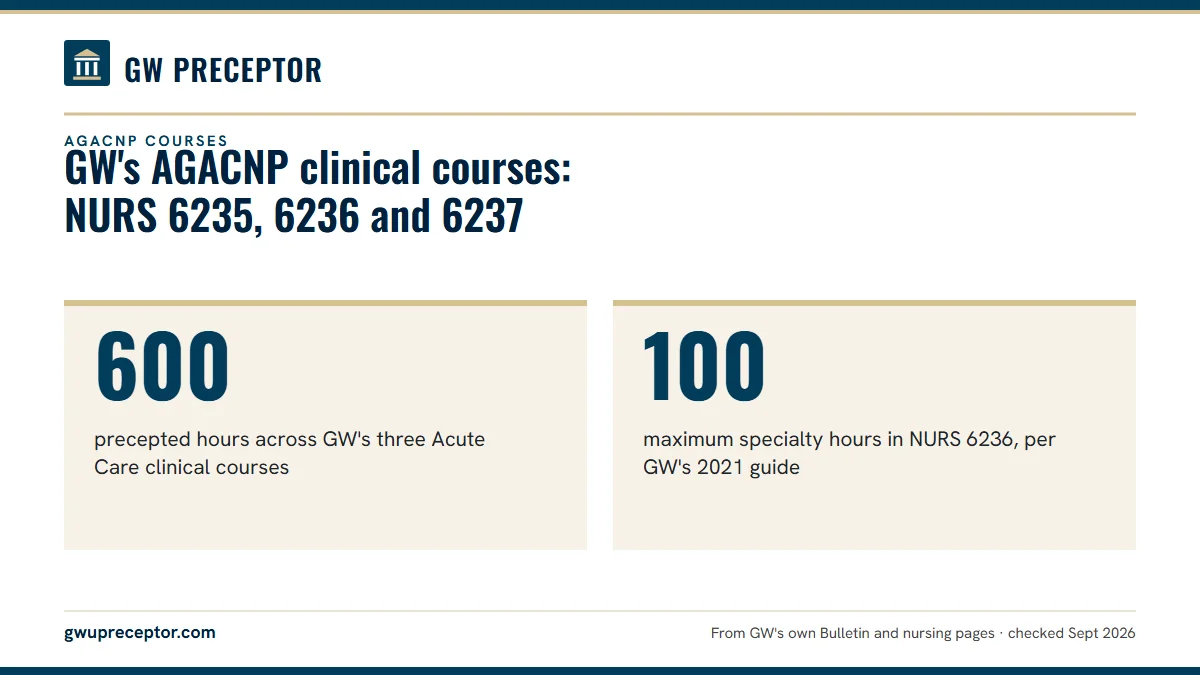
GW's Acute Care NP track asks for 600 precepted hours: 120 in NURS 6235, then 240 apiece in NURS 6236 and NURS 6237. The sequence starts on hospital medicine or step-down units, moves into critical care, and finishes in critical care or the post-acute settings where older adults recover. Each course also brings you to campus for a simulation event.
Get your placement plan
Tell us your GW program and where you live. A placement advisor replies with the preceptor and site options that fit your GW course.
The Acute Care sequence in one table
| Course | Title | Credits | Hours | Setting in GW's 2021 guide |
|---|---|---|---|---|
NURS 6235 | Adult-Gerontology Acute Care Nurse Practitioner I: Introduction to Practice | 4 | 120 | Hospital medicine, telemetry or intermediate care |
NURS 6236 | Adult-Gerontology Acute Care Nurse Practitioner II: Complex and Acute Illness | 8 | 240 | Critical care, with up to 100 specialty hours |
NURS 6237 | Adult-Gerontology Acute Care Nurse Practitioner III: Complex and Chronic Disease Mgt Adolesc/Elderly | 8 | 240 | Critical care, long-term care, rehabilitation or geriatric settings |
GW's 2021 clinical placement guide supplies the setting column. GW still hosts that file, but it has dropped out of the school's current links, and today's syllabi may word things differently. Your Clinical Experience Faculty can confirm each course's current expectations.
Every Acute Care option, whether MSN, post-BSN DNP or certificate, runs these three courses at these hours, so everything below applies to you.
NURS 6235: hospital medicine and step-down units
The introduction to Acute Care practice is 120 hours on a hospital medicine service, a telemetry unit or an intermediate care unit, according to GW's 2021 guide. These are the floors where you learn admissions, daily progress notes, cross-cover and discharge planning for adults who are sick but not in intensive care.
A strong 6235 preceptor is a hospitalist nurse practitioner or physician, or an acute care NP who covers a telemetry or step-down population. Your critical care experience, which GW requires for admission, helps here: you already know the units, and now you see them from the provider side.
Before clearance, Acute Care students also upload an ACLS card, current and issued by the AHA or the Red Cross, to Complio; the Complio guide lists the rest.
NURS 6236: critical care, with a specialty window
The second course doubles the time to 240 hours and moves you into critical care. GW's 2021 guide places NURS 6236 there and allows up to 100 hours in a specialty. The title, Complex and Acute Illness, matches the intensity of the setting.
Preceptors are typically intensivists, critical care NPs and acute care NPs embedded in medical, surgical, cardiac or neuro intensive care units. If you use the specialty allowance, choose a consult service or unit that complements your ICU time, and give that preceptor a Site Prospector entry of their own.
Many Acute Care students already work in an ICU. Whether your own unit can host your hours is a question GW's current pages leave open; the workplace clinical site page sets out what GW has said and how to raise it with your program director.
NURS 6237: critical care or post-acute recovery
The final 240 hours offer the widest choice in the sequence. For NURS 6237, GW's 2021 guide opens four doors: critical care, long-term care, rehab, or a geriatric setting. The course title points at complex and chronic disease management from adolescents to the elderly.
That range lets you shape the end of the program. A student aiming for an ICU job can stay in critical care; one drawn to long-term acute care or inpatient rehabilitation can finish there, working with NPs and physicians who manage medically complex older adults after a hospital stay.
Whichever path you pick, raise it with your Clinical Experience Faculty early, because the choice changes who you need to contact and how far ahead.
Simulation events on campus
Acute Care is the one GW track where every clinical course carries a campus requirement. The program page makes AGACNP Clinical Simulation Events mandatory during each of your three rotations, and the Bulletin's version is broader still: several on-campus experiences covering coursework, clinical skills and patient assessment. CLASI comes first, before 6235.
How many events you attend is where GW's pages part ways: the certificate page counts two simulation-based learning events on campus, fewer than one per course. Your program director and the NP On-Campus Events Dashboard settle which events apply to your plan.
Tell each preceptor about the simulation dates at your first meeting, since they fall inside a semester where every hour must be logged within term dates. The OSCE and skills assessment guide covers the on-campus model across all NP tracks.
Where and when the Acute Care courses run
Acute Care clinicals take place only in DC, Maryland or Northern Virginia, with GW's program director closely involved in choosing sites; the AGACNP placements page explains GW's differing wording on who arranges them.
The MSN is part-time only, eight semesters on GW's November 2024 plan, with NURS 6235 in the summer of year two, 6236 in fall and 6237 in spring. The post-BSN DNP starts the same run in the summer of year three. Certificate students begin with 6235 in their first term, a summer, and finish with 6237 the following spring.
Older GW text sometimes shows 650 Acute Care hours split 150, 250 and 250. That comes from a 2017 page and legacy blocks on certificate pages; the current figure is 600.
Why Acute Care students choose us
Acute Care placements run through hospitals, where agreements, credentialing and unit onboarding all take time. We identify hospitalist, intensivist and acute care NP preceptors inside the region GW allows, matched to each course: a medicine or step-down service for 6235, an intensive care unit for 6236, and critical care or a post-acute setting for 6237.
Each candidate comes with a full CORE-ready packet: license, CV or GW preceptor bio, the hospital official who signs affiliation agreements, and a clear case for course fit. Your program director, who stays closely involved in Acute Care placements, reviews a complete file and makes the decision. If a unit changes its plans, we line up the next option quickly. See how it works or start with the contact form.
Questions GW students ask
Do AGACNP students need ACLS for clinicals?
Yes. GW's Compliance and Clinical page lists ACLS for Acute Care students only, and the card must be current and issued by the AHA or the Red Cross. It goes into Complio alongside the rest of your pre-clinical items. Keep it current through NURS 6237, since an expired card can pause clearance in the middle of the sequence.
Why does an older GW page say Acute Care needs 650 hours?
In 2017, GW's Acute Care requirement was 650 hours split 150, 250 and 250, with an optional summer role immersion. Some certificate pages still carry that text in hidden legacy blocks. GW's current program pages and the Bulletin 2026-27 say 600 hours, at 120, 240 and 240 across NURS 6235 to NURS 6237.
Does the AGACNP certificate use the same clinical courses?
Yes. The post-master's AGACNP certificate is 20 credits built on NURS 6235, NURS 6236 and NURS 6237 with the same 600 hours. GW's sources differ on its length: the November 2024 plan shows three semesters, the certificate page says five part-time, and the Bulletin allows three for applicants already certified as FNPs or AGPCNPs.
Where are the AGACNP simulation events held?
The school's FAQ points to Ashburn, home of GW Nursing's simulation center, as the usual venue for on-campus testing and training. Some 2026-27 NP events, such as the FNP and AGPCNP OSCEs, are at Ross Hall in Foggy Bottom instead. The NP On-Campus Events Dashboard at go.gwu.edu/NPevents shows the venue for each event.
Related pages
Last checked 2026-09-24
We check these pages against GW's Bulletin and GW Nursing's own program and clinical pages. Your course, CORE and GW's Clinical Placement Team have the final word.
GW asks you to find your own site and preceptor. Hand that search to us.
Tell us your GW program, where you live and which clinical course is next. We find preceptors who fit the course and prepare the license, bio and site details GW's review asks for, so your Site Prospector goes in complete.
- Preceptors matched to the course: family practice for
NURS 6230toNURS 6232, older-adult primary care for AGPCNP, psychiatric care for PMHNP - License, bio or CV and the site's agreement signatory ready for your CORE submission
- Close to home, in DC, Maryland, Virginia or wherever you live and hold your RN license
Start your placement plan
Your program, city and next clinical term is all we need to begin.