Can't find a preceptor for your GW clinical course
Start with what GW already hands you: the Clinical Placement Team's record of sites GW students have used in your state, the Clinical Site Database in CORE, and the "intervention and support" GW's placement model offers whenever a preceptor says no. If those leads run dry, the quickest way forward is a full search run on your behalf, with every document GW's review needs gathered before your Site Prospector submission goes in.
Get your placement plan
Tell us your GW program and where you live. A placement advisor replies with the preceptor and site options that fit your GW course.
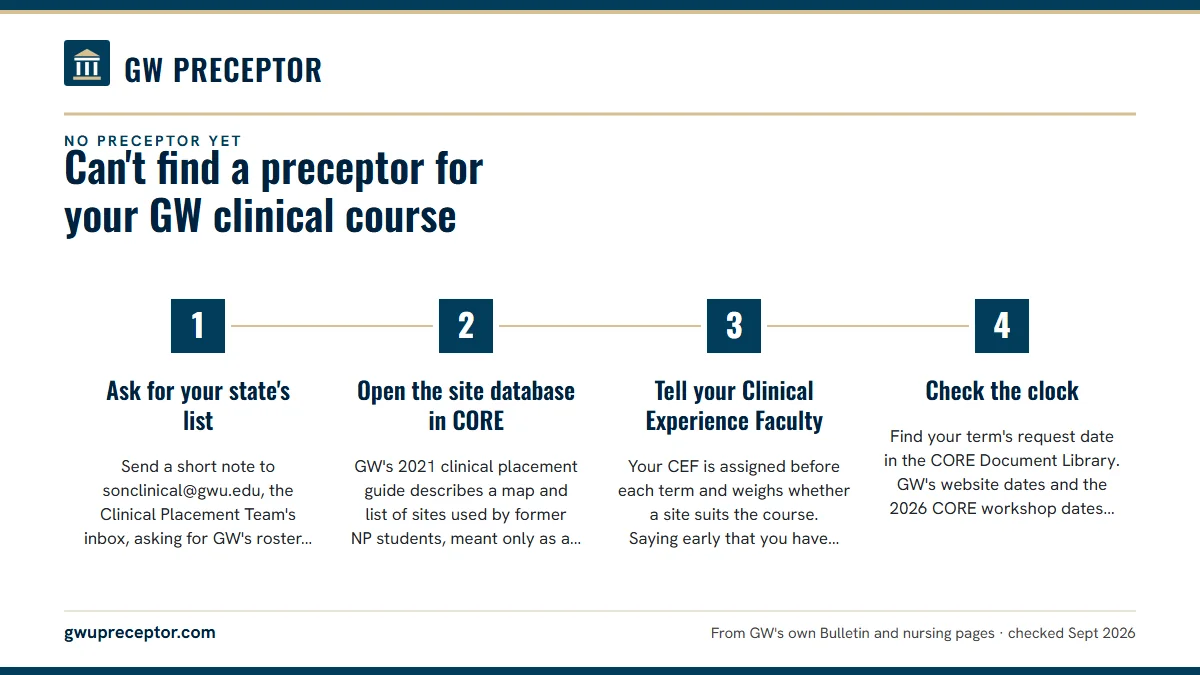
This week: four moves that restart a stalled search
- Ask for your state's listSend a short note to sonclinical@gwu.edu, the Clinical Placement Team's inbox, asking for GW's roster of past sites and preceptors where you live.
- Open the site database in COREGW's 2021 clinical placement guide describes a map and list of sites used by former NP students, meant only as a resource guide. The site database page explains how to read it.
- Tell your Clinical Experience FacultyYour CEF is assigned before each term and weighs whether a site suits the course. Saying early that you have nothing yet brings faculty into the hunt for alternatives while there is time to use them.
- Check the clockFind your term's request date in the CORE Document Library. GW's website dates and the 2026 CORE workshop dates differ, and the request deadlines page sets them side by side.
What GW's "intervention and support" covers
GW's Clinical Placement Model has five steps, and the second belongs to you: students identify their own sites and preceptors. When a preceptor declines, is unavailable or is not approved, the model sends you back to that step with ongoing help. The FAQ says it differently, promising all the support GW can give while leaving the securing of a site with the student.
What GW publishes about that help
- A state-by-state record of past GW sites and preceptors, sent when you ask
- The Clinical Site Database inside CORE
- Mentoring on approaching preceptors, plus networking access
- A clinical webinar invitation during your
NURS 6220semester - Faculty or program director help with alternatives when a site is judged a poor fit (GW's 2021 guide)
Acute Care students sit apart. GW's sources disagree on whether the program director arranges AGACNP placements or chooses them with you, so confirm with your program; the AGACNP placement page lays out the conflict.
Work GW's search tips harder than your classmates
GW's Compliance and Clinical page lists its own ways to find a preceptor. Your whole cohort reads the same list, so the edge comes from how deliberately you use each one.
- Providers where you work: ask your manager who took a student last year.
- NP and midwifery friends, classmates and alumni: GW graduates know which offices say yes to GW students.
- Local NP or midwifery associations: a chapter meeting reaches clinicians who ignore cold email.
- LinkedIn: search by credential and town, then send three sentences naming GW Nursing, your course number and your term.
- Office visits: GW suggests speaking with the practice manager, who often controls student slots.
- Your own clinicians: the NP or physician who treats you already knows you.
- Preceptor swaps: a 2021 version of GW's page suggested trading with classmates.
GW's Clinical Rotations page tells students to have a resume and the school's clinical requirements on hand. When a clinician sounds interested, send both within the hour.
Why GW students get stuck
Timing comes first. GW's own clinical page cautions that plenty of practices are booked solid over a year out, so a search that begins a term or two early still competes for leftovers.
The DC region is crowded. Students report that the difficulty depends on how many NP students an area already holds, and one GW alum described classmates driving more than four hours round trip or relocating for a term. MedStar Health's academic partnership page says graduate students must bring their own preceptor to be considered, and Reston Hospital Center's page names teaching ties with four other area nursing schools.
The list has limits too. A name on it proves a site hosted a GW student once, not that the clinician has room this term, and students report that listed preceptors may not take new students.
Specialty rotations narrow the field further
Some courses call for a particular preceptor or setting, and those slots disappear first. GW's 2021 clinical placement guide describes them; confirm the current rule in your course.
| Course | What the rotation needs | Where GW says so |
|---|---|---|
NURS 6231 (FNP II) | OB/GYN, about 60 OB and 60 GYN hours, plus pediatrics | GW's 2021 guide |
NURS 6229 (AGPCNP III) | At least 120 hours in nursing homes or long-term care | GW's 2021 guide |
NURS 6236 (AGACNP II) | Critical care, up to 100 specialty hours | GW's 2021 guide |
NURS 6248 (PMHNP) | A PMHNP or CNS preceptor | GW's 2021 guide |
NURS 6258 and NURS 6259 | A master's-prepared preceptor, and a new preceptor and site for the second practicum | Leadership program page |
GW's baseline sits underneath all of this: the right credential (NP, MD, DO or CNM), a minimum of two years practicing at an advanced level, and an active license with no encumbrances. The preceptor requirements page has the full rule.
How we search for you
Our search is built around GW's own process, so what comes back is a preceptor who has already agreed to your course, term and hours, with the paperwork in hand. Your placement advisor starts from your plan of study and your course setting, then works contacts in your own area, in person where you live.
What you receive
- A preceptor who meets GW's credential rules, confirmed for your exact term
- License details and a bio or CV, ready to attach to your Site Prospector submission
- The site's authorized signatory, so the Clinical Placement Team can start or confirm the affiliation agreement quickly
- A course-fit summary for your program director and Clinical Experience Faculty
- A replacement search if a preceptor drops out
Approval stays with GW's program director and clearance with the Clinical Placement Team; our part is handing them a file with nothing missing. Read how it works, or tell us your course and term with the form below.
Questions GW students ask
Does GW place graduate students who come up empty?
Outside the Acute Care options, the search stays with you. GW's rule makes each graduate student responsible for lining up a site and preceptor, and the help it offers is a state record of past sites, the CORE database, mentoring and faculty input on alternatives. The on-campus pre-licensure programs in Ashburn are the other group GW places itself.
Can a physician assistant be my GW preceptor?
Probably not without a direct yes from your program. GW's 2021 clinical placement guide accepts preceptors credentialed as an NP, MD, DO or CNM, and physician assistants are missing from every GW source reviewed. When a PA volunteers, check with your program director before anything goes into CORE, since an unapproved preceptor restarts the whole search.
Should I call sites on GW's list or look elsewhere first?
Both at once. Listed sites may already hold an agreement with GW, which can shorten the path to clearance, but the same names go to anyone in your cohort who asks. Leads from your workplace, alumni and local associations face less competition, so work them in parallel.
Is it too late to find a preceptor for next term?
Often not, but the window is narrow. GW asks for requests three to four months ahead of the term, and the 2026 CORE workshop deck says you need a site by the end of week two. The fast placement page explains what is still realistic.
What happens if I still have no site by mid-semester?
GW's 2021 clinical placement guide treats mid-semester as a checkpoint. A student still without a site sits down with the Clinical Experience Faculty and program director, and together they judge whether this term's course goals are still reachable. Flag the problem weeks before that, since faculty help and new agreements both need lead time.
Related pages
Last checked 2026-09-24
We check these pages against GW's Bulletin and GW Nursing's own program and clinical pages. Your course, CORE and GW's Clinical Placement Team have the final word.
GW asks you to find your own site and preceptor. Hand that search to us.
Tell us your GW program, where you live and which clinical course is next. We find preceptors who fit the course and prepare the license, bio and site details GW's review asks for, so your Site Prospector goes in complete.
- Preceptors matched to the course: family practice for
NURS 6230toNURS 6232, older-adult primary care for AGPCNP, psychiatric care for PMHNP - License, bio or CV and the site's agreement signatory ready for your CORE submission
- Close to home, in DC, Maryland, Virginia or wherever you live and hold your RN license
Start your placement plan
Your program, city and next clinical term is all we need to begin.