GW's post-master's NP certificates: 600 hours, starting in your first semester
GW's AGPCNP and AGACNP post-master's certificates fit 600 precepted hours into three clinical courses, and most certificate students begin clinicals in their very first semester. That leaves no warm-up term for a preceptor search. The FNP certificate is not taking applications. Here is what each certificate requires and how to have a preceptor ready on day one.
Have a preceptor ready for term one
Tell us which certificate, your start term and your city. Your placement advisor starts the search as soon as you are accepted.
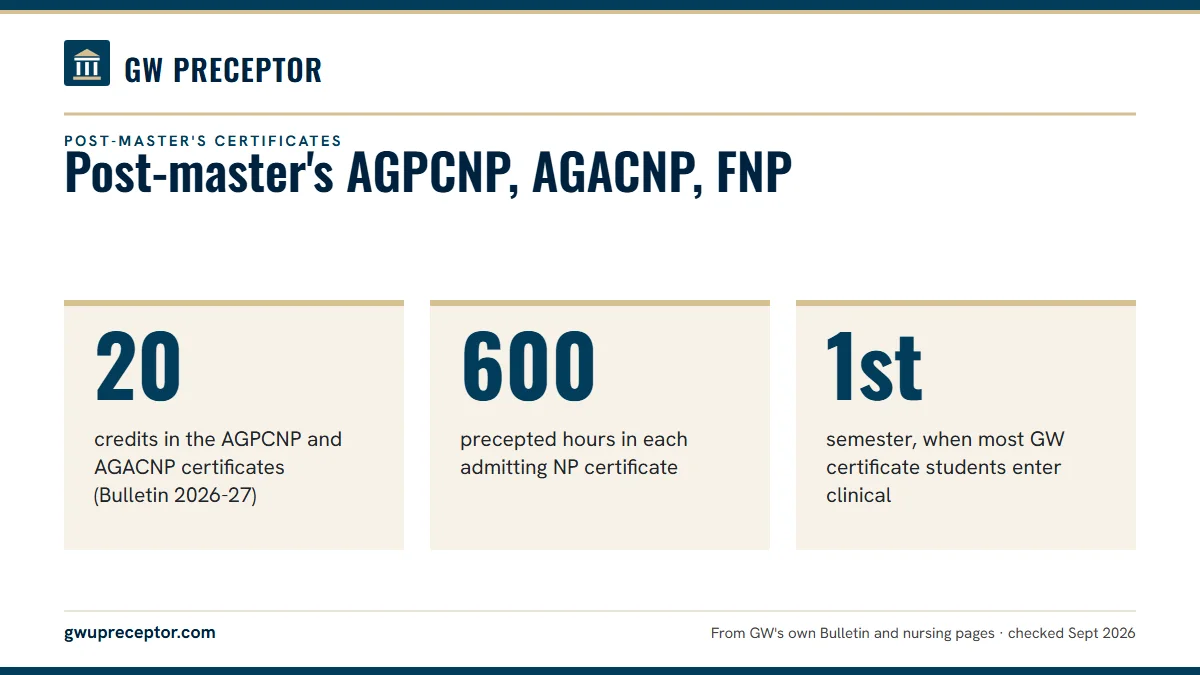
The certificates at a glance
| Certificate | Credits | Precepted hours | Start | Length | Status |
|---|---|---|---|---|---|
| AGPCNP | 20 | 600: NURS 6224, NURS 6225, NURS 6229 | Summer; the November 2024 plans also show fall | 3 semesters | Admitting |
| AGACNP | 20 | 600: NURS 6235, NURS 6236, NURS 6237 | Summer | 3 semesters (plan and Bulletin) or 5 (website) | Admitting |
| FNP | 17 | 600 in the Bulletin, 500 on the website | Summer | Not published | Not admitting |
Each admitting certificate consists of the three clinical courses from the matching MSN; the foundation work comes from the master's you already hold. With no pre-clinical course inside, the clock starts early. The Bulletin's regulations give the AGPCNP, AGACNP and FNP certificates a four-semester time limit, which sits oddly beside the website's five-semester wording for the AGACNP option; ask the program director which applies to you.
Clinicals from the first semester
GW's Compliance and Clinical page states it directly: the majority of post-master's certificate students enter clinical in the first semester, and they are responsible for securing their own site and preceptor. The November 2024 plans agree, with NURS 6224 or NURS 6235 in semester one. GW's 2021 clinical placement guide told certificate students to start searching "immediately upon program acceptance."
Two practical steps follow. CORE access normally opens before NURS 6222, a course certificate students do not take, so GW asks students starting clinical in their first semester to email the Clinical Placement Team at sonclinical@gwu.edu for access. And the website's clinical request dates, February 1 for summer and May 1 for fall, fall about four months ahead, so a first-semester request can fall due soon after you are admitted. The request deadlines page compares those dates with CORE's.
Complio has its own timing rule: buy it no more than four months before clinicals start. See Complio requirements.
Certificate students have no pre-clinical term. Begin the preceptor search the day you are accepted, not the day classes start.
AGPCNP certificate
The primary care certificate asks for an MSN plus graduate pathophysiology, pharmacology and health assessment, taken as "three separate courses, across the lifespan." The Bulletin and website list a summer start, and GW's November 2024 plans show both summer and fall entry, each finishing in three semesters: summer, fall, spring, or fall, spring, summer.
The three courses are the same ones MSN and DNP students take, 120, 240 and 240 hours. GW's program page asks you to complete CLASI on campus before clinicals and OSCEs during NURS 6225 and NURS 6229. Its placement tab simply says you are encouraged to find your own preceptor.
Settings shift across the three courses. GW's 2021 clinical placement guide set at least 120 hours in nursing homes or long-term care for the third course; the AGPCNP clinical courses page covers each one.
AGACNP certificate
The acute care certificate adds regional and experience rules. You need an MSN in nursing, at least a year of full-time critical care experience (ICU, trauma, CCU or emergency department; the plan says within the past five years), current ACLS, and a home in Maryland, Northern Virginia or DC while you take the clinical courses. GW's State Authorizations page excludes Washington-state applicants from every AGACNP option.
Length is a three-way conflict. The November 2024 plan shows three semesters, NURS 6235 in summer, NURS 6236 in fall and NURS 6237 in spring. The Bulletin says three semesters for applicants already certified as FNPs or adult-gerontology primary care NPs. The website calls it a part-time option completed in five semesters.
On-campus wording also varies: the page mentions two simulation-based events and, elsewhere, acute care simulation events during all three clinical courses. The certificate's placement tab encourages you to find your own preceptor, while the Bulletin says placements are selected jointly with the program director. The AGACNP placements guide explains that exception.
FNP certificate: not admitting
GW's FNP certificate page says "Applications are not currently being accepted." It was built for NPs already certified in another population: the Bulletin lists women's health, pediatric, adult-gerontology primary care and acute care nurse practitioners as eligible.
Its 17 credits pair a variable-credit practicum, NURS 6227 Family Nurse Practitioner Clinical Practicum, with NURS 6250, NURS 6251 and NURS 6252. OSCEs fall in NURS 6251 and NURS 6252, and a faculty member conducts a site visit, usually during the second or final clinical course. The hour total conflicts: 600 in the 2025-26 and 2026-27 Bulletins, 500 on GW's website. Students still enrolled should confirm their target in the course syllabus and CORE. GW's page also notes that the certificate is not eligible for federal funding, and its posted plan was a summer-entry, part-time schedule.
Where you can live and who can apply
GW's State Authorizations page lists Tennessee and Utah as excluded from all of its post-master's NP certificates. The school-wide limits apply too: no online applicants from Alabama, Louisiana, Mississippi, North Dakota or Wisconsin, and New York applicants only if they complete clinicals in another state. See state authorizations. Outside those limits, certificate students rotate where they live, except in the AGACNP option, which keeps its clinicals in DC, Maryland and Northern Virginia.
GW's FAQ contradicts itself on direct-entry MSN and CNL graduates: one sentence calls them ineligible for post-master's certificates, another says they must first complete the advanced pathophysiology, pharmacology and health assessment courses. Ask admissions before you apply. Wherever you rotate, you need an RN license in that state; the RN license page explains GW's rule.
Why certificate students start with us
A certificate leaves no room for a slow search, and speed is where we are strongest. Your placement advisor starts the day you tell us you are accepted, lines up the first-semester preceptor near your home, and plans the next two courses at the same time, so the later terms are in motion early.
We prepare what GW's review looks for on each Site Prospector submission: the preceptor's license and bio or CV, the site's agreement signatory and a clear fit to the course. For AGACNP students we focus on acute care preceptors in DC, Maryland and Northern Virginia and have candidates ready if the program director asks. GW's program director gives the final approval; we make sure what reaches them is complete the first time. Start with the form below.
Questions GW students ask
Can I start GW's AGPCNP certificate in the fall?
The Bulletin and GW's program page list a summer start, and the most recent deadlines shown are for Summer 2027. GW's November 2024 plans also include a fall-entry version finishing in three semesters. Check the live admissions page for the terms open in your year before planning your first clinical course.
Why is there no health assessment course in the certificate?
You bring it with you. The AGPCNP certificate's entry rules call for graduate pathophysiology, pharmacology and health assessment already completed, so the certificate holds only the three clinical courses. GW's program page still lists CLASI on campus before clinicals, so plan for that event even though NURS 6222 is not in your plan.
I live in Tennessee. Can I take a GW NP certificate?
Not under GW's current State Authorizations page, which excludes Tennessee and Utah from all four post-master's NP certificates. That exclusion is listed for the certificates; the same page does not list Tennessee or Utah against the MSN or post-BSN DNP nurse practitioner tracks. Confirm the current list with admissions before you apply.
Does GW find preceptors for certificate students?
GW's Compliance and Clinical page says certificate students are responsible for securing their own site and preceptor. GW supports the search: the Clinical Placement Team can share a list of sites and preceptors earlier students used in your state, and the program director reviews every request. AGACNP students work more closely with the program director on placements.
Will GW visit my certificate clinical site?
GW's FNP certificate page says a faculty member conducts a site visit, usually during the second or final clinical course, and older text on the AGACNP and AGPCNP certificate pages says the same. Whether the visit happens in person or virtually is not published, so ask your Clinical Experience Faculty when your term begins.
Related pages
Last checked 2026-09-24
We check these pages against GW's Bulletin and GW Nursing's own program and clinical pages. Your course, CORE and GW's Clinical Placement Team have the final word.
GW asks you to find your own site and preceptor. Hand that search to us.
Tell us your GW program, where you live and which clinical course is next. We find preceptors who fit the course and prepare the license, bio and site details GW's review asks for, so your Site Prospector goes in complete.
- Preceptors matched to the course: family practice for
NURS 6230toNURS 6232, older-adult primary care for AGPCNP, psychiatric care for PMHNP - License, bio or CV and the site's agreement signatory ready for your CORE submission
- Close to home, in DC, Maryland, Virginia or wherever you live and hold your RN license
Start your placement plan
Your program, city and next clinical term is all we need to begin.