Grades, repeats and clinical course failure at GW Nursing
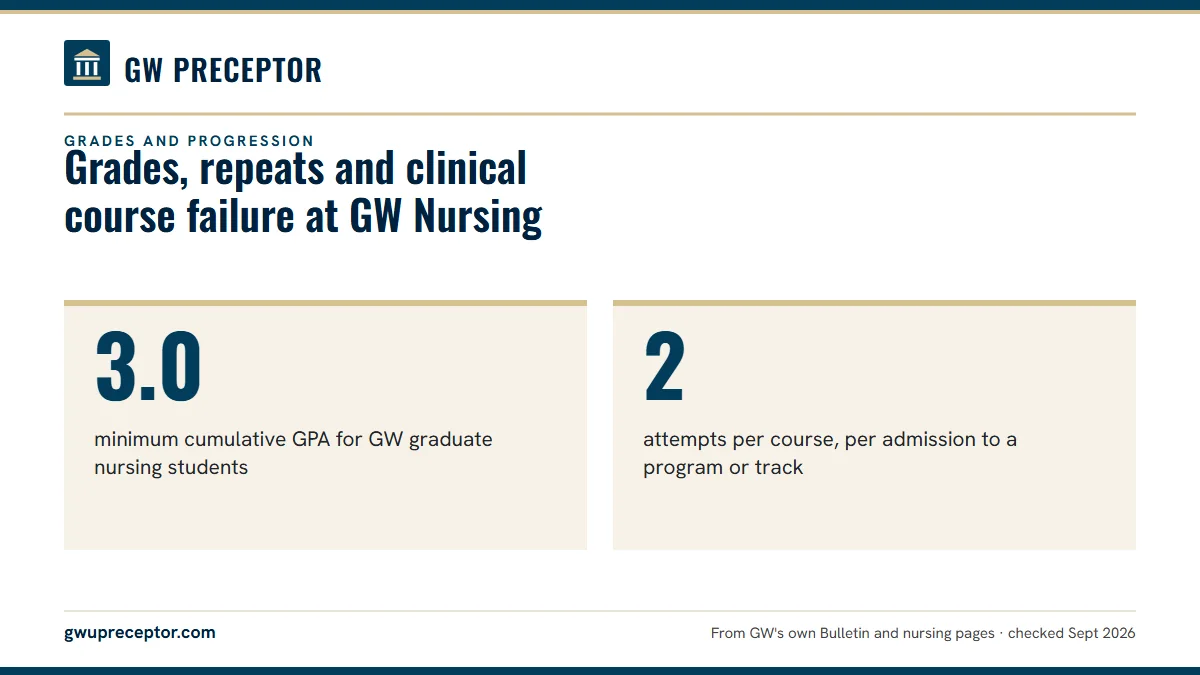
GW's 2026-27 Bulletin sets the bar at a B in every MSN, DNP and graduate certificate course, electives included, and gives you two attempts at each one. A second unsatisfactory grade in a required course is listed among the grounds for dismissal, and because GW's NP clinical courses run in a fixed order, one failed rotation can move every term that follows it.
Get your placement plan
Tell us your GW program and where you live. A placement advisor replies with the preceptor and site options that fit your GW course.
The minimum grade: a B, even in electives
The School of Nursing regulations in the Bulletin state the graduate rule with no carve-outs: "For MSN, DNP, PhD and graduate-level certificate students a minimum grade of B is required for all courses, including electives." Graduate students must also keep a cumulative GPA of at least 3.0 across the program. A clinical course is held to the same B as a biostatistics or policy course. The difference is that part of a clinical grade rests on hours, encounter logs and preceptor evaluations, which all depend on a placement that lasts the term.
Undergraduates work under a split rule. BSN students need a GPA of 2.8 and a C+ in most courses, but a B in the clinical ones: NURS 3124, NURS 3125, NURS 4124, NURS 4125, NURS 4126, NURS 4127 and NURS 4217. GW's 2023-24 undergraduate handbook puts a B at 83 to 86 and a B- at 80 to 82, and it rounds only the final course grade, from 0.50 up. No current graduate handbook is public, so the scale printed in each course syllabus is the one to go by.
Two attempts per course, and what counts against you
The repeat rule in the Bulletin is brief. You get two attempts to pass each course, counted per admission to a specific program or track. Both grades stay on your transcript and both are calculated into your final GPA, so a strong repeat sits beside the first result rather than replacing it. Reinstatement after a dismissal does not reset the count, and the Bulletin adds that the second try is not assured when grounds for dismissal already exist.
Grounds for dismissal the Bulletin names (its list is not exhaustive)
- An unsatisfactory grade in a required course a second time
- Two or more unsatisfactory grades in one term
- Remaining on academic probation for two consecutive semesters
- Not completing degree or certificate requirements within the time limit
- Academic misconduct found by an Academic Integrity Panel
- Violating professional comportment standards
The second item is easy to miss: two unsatisfactory grades in the same term are grounds on their own, even when neither course is a repeat.
Why one clinical grade moves the whole plan
GW builds its NP clinical courses as a chain. NURS 6222 Advanced Health Assessment is a prerequisite to every other clinical NURS course, and the sample plans of study schedule it for the semester before clinicals begin. After that, each track's plan runs its clinical courses in back-to-back terms. FNP moves from NURS 6230 (120 hours) to NURS 6231 and NURS 6232 (240 hours each), and the full-time fall FNP plan places them in summer, fall and spring. The FNP course page lays out that sequence, and first clinical semester shows where it starts for each plan.
Because the next clinical course normally begins the following term, repeating one tends to push back everything after it, including the OSCEs tied to your second clinical course. Site Prospector submissions are filed per term, so a course that shifts needs fresh submissions for its new term. PMHNP students follow a longer chain of five 120-hour courses opening with NURS 6245, and a slip there ripples through more terms.
For undergraduates, the 2023-24 handbook says an Incomplete in a prerequisite blocks the next required course, and a student who fails a prerequisite must petition to register outside the plan of study. The graduate version of those rules is not public, so your program director and academic advisor set any revised plan.
How a clinical course gets into trouble
Most clinical course failures begin with the placement, not the exam. The 2026 CORE workshop deck insists that all clinical hours sit within semester dates and that students have a site secured by the end of week 2. GW's 2021 clinical placement guide adds that anyone still lacking a site halfway through the term meets the Clinical Experience Faculty and program director to judge whether the course's objectives remain reachable. Current rules may differ, but the arithmetic does not: 240 hours cannot be packed into the final weeks of a term.
Other routes are rarer and more serious. The same 2021 guide says starting at a site before clearance can be grounds for dismissal, and that hours recorded without the right license are not counted. For BSN students, the 2023-24 handbook requires missed clinical time to be made up, and a student whom a site asks to remove may end with an Incomplete or a repeat if no alternative can be arranged. The Bulletin's comportment standard lists behaviors such as breaching patient confidentiality or acting beyond a student's scope. The Incomplete rules are covered with the calendar.
A preceptor who leaves mid-term is a placement problem before it is a grade problem: tell the Clinical Placement Team and your Clinical Experience Faculty right away.
Probation, appeals and time limits
Graduate students go on probation when the cumulative GPA falls below 3.0, and probation brings an Academic Success Plan that the associate dean approves. A dismissal can be appealed within 5 business days to the associate dean; the ASAC Standing Progression Subcommittee reviews the case and makes a recommendation, and the dean's decision is final. A comportment sanction has a separate appeal, due to the dean within 7 calendar days.
Every program also has a clock, measured in semesters. Approved leaves of absence and military deployment are excluded from it, but a repeated clinical course is not, which is one more reason to rescue a stalled placement quickly.
| Program | Time limit |
|---|---|
| BSN and Direct-Entry MSN | 6 semesters |
| MSN | 13 semesters |
| Post-master's AGACNP, AGPCNP or FNP certificate | 4 semesters |
| Post-master's PMHNP certificate | 6 semesters |
| Post-BSN DNP | 16 semesters |
| Post-MSN DNP | 13 semesters |
Where GW's grade rules are written
The current rules sit in the School of Nursing Regulations of the GW Bulletin 2026-27, which is labeled a provisional edition. It covers grades, repeats, probation, dismissal, leave and time limits, and it is the document to cite in any appeal. GW's Forms page carries the Grade Appeal form and the Request for Policy Exception form.
Handbooks are patchier. GW's older Policies and Handbooks page, now missing from the 2026 site navigation, linked an undergraduate and a graduate handbook. The 2023-24 undergraduate handbook still downloads and covers the Accelerated BSN, Veterans BSN and RN-BSN. The 2023-24 graduate handbook link now returns an error and no newer edition was found in September 2026. The university-wide graduate handbook is a different document. For graduate questions the Bulletin leaves open, the academic advisor the Office of Student Services assigns to your track and your program director are the deciding sources.
Why GW students choose us
A failed clinical course usually traces back to lost weeks: a preceptor who withdraws, an agreement that stalls, a replacement found too late to fit the hours inside the term. We are built to close that gap. When a GW placement breaks, your placement advisor starts a replacement search in the same specialty near you and gathers the preceptor's license and CV or bio plus the name of the site's agreement signer, so the new Site Prospector entry goes in whole.
GW's program director still approves every preceptor and the Clinical Placement Team still clears you; we put a strong, complete option in front of them fast. If a rotation is already at risk, read preceptor dropped out and behind on clinical hours, then share your course number and term on the contact form.
Questions GW students ask
Is a B- passing in GW's MSN or DNP courses?
No. The Bulletin requires at least a B in every course for MSN, DNP, PhD and graduate certificate students, electives included, so a B- falls below the minimum. GW's 2023-24 undergraduate handbook places a B- at 80 to 82 percent. For graduate courses, rely on the grading scale in your syllabus, since no current graduate handbook is public.
Does withdrawing from a clinical course use up one of my two attempts?
The Bulletin gives two attempts per course, per admission to a program or track, but it does not say whether a W counts as one. Before you withdraw from a clinical course, ask your academic advisor and program director how it will be recorded, and keep the answer in writing. Withdrawing after the add and drop deadlines already needs the program director's and associate dean's permission.
Will passing a repeated course replace the failing grade in my GPA?
No. GW's Bulletin keeps both grades on your transcript and counts both in your final GPA. A good repeat can lift you back above the 3.0 cumulative minimum, but the first grade stays in the calculation for the rest of the program.
Can a clinical site's complaint lead to failing the course?
It can. GW's 2023-24 undergraduate handbook says that when a site asks for a student to be removed, the program director or dean is notified, an alternative may not be possible, and the outcome can be an Incomplete or a repeat. For every student, the Bulletin's technical standards require meeting the terms of the clinical affiliation agreement and any site requirements.
Where is the GW Nursing graduate student handbook?
A current one is not publicly available. The 2023-24 graduate handbook's Box link returns an error and no later edition turned up in September 2026, while the 2023-24 undergraduate handbook still downloads. The School of Nursing Regulations in the Bulletin 2026-27 hold the current graduate rules, and your advisor can confirm anything they leave open.
Related pages
Last checked 2026-09-24
We check these pages against GW's Bulletin and GW Nursing's own program and clinical pages. Your course, CORE and GW's Clinical Placement Team have the final word.
GW asks you to find your own site and preceptor. Hand that search to us.
Tell us your GW program, where you live and which clinical course is next. We find preceptors who fit the course and prepare the license, bio and site details GW's review asks for, so your Site Prospector goes in complete.
- Preceptors matched to the course: family practice for
NURS 6230toNURS 6232, older-adult primary care for AGPCNP, psychiatric care for PMHNP - License, bio or CV and the site's agreement signatory ready for your CORE submission
- Close to home, in DC, Maryland, Virginia or wherever you live and hold your RN license
Start your placement plan
Your program, city and next clinical term is all we need to begin.