GW's post-BSN DNP in Family Nurse Practitioner: the plan, the hours and your preceptors
GW's Family Nurse Practitioner DNP takes a BSN-prepared nurse to the doctorate in 72 credits over four part-time years, with no master's degree handed out along the way. The precepted work comes late: NURS 6230, NURS 6231 and NURS 6232 fill the last three terms, and finding the preceptors for them is your job. This guide sets out the plan, GW's hour figures and the point where your search has to begin.
Plan your DNP FNP rotations
Tell us your start year, your city and your first clinical term. Your placement advisor maps preceptors for all three FNP courses.
What the 72 credits contain
The Bulletin 2026-27 builds the Family NP doctorate from four blocks. Only one of them needs a preceptor, and it is the smallest block by count: three courses worth 20 credits.
The doctoral layer is where this degree parts ways with the MSN. It holds eight 3-credit courses, from NURS 8400 Epidemiology and Population Health to NURS 8419 Analytical Methods and Appraisal for Evidence-Based Practice, then the project sequence. One course changed in the newest catalog: Healthcare Informatics (NURS 8351) now fills the slot that the 2025-26 edition and the older plans of study gave to Knowledge Management in Nursing (NURS 8402). The DNP project courses guide covers the project itself.
GW describes its post-BSN doctorate as entry-level NP preparation "without a master's exit point." In plain terms, no MSN is awarded partway through; the degree you finish with is the DNP.
| Block | Courses | Credits |
|---|---|---|
| Advanced practice base | NURS 6208, NURS 6220, NURS 6222, NURS 6233, NURS 6234 | 16 |
| Family NP clinical courses | NURS 6230, NURS 6231, NURS 6232 | 20 |
| Doctoral core | NURS 8351, NURS 8400, NURS 8401, NURS 8403, NURS 8405, NURS 8417, NURS 8418, NURS 8419 | 24 |
| DNP project | NURS 8489 to NURS 8492 | 12 |
The four-year part-time plan
GW posts only part-time plans for its post-BSN DNP tracks, and each one runs 11 semesters, summers counted, from fall of year one to spring of year four. The Family NP doctorate admits in the fall only. The Bulletin's regulations allow up to 16 semesters to finish, which matters if a lost rotation ever pushes a course back a term.
| Semester | Term | Clinical milestone |
|---|---|---|
| 1 | Year 1 fall | Program start |
| 2 to 7 | Year 1 spring to year 3 fall | Foundation and doctoral courses; no precepted clinical course yet |
| 8 | Year 3 spring | NURS 6222 with CLASI; CORE access opens before this course |
| 9 | Year 3 summer | NURS 6230, 120 hours |
| 10 | Year 4 fall | NURS 6231, 240 hours, with an OSCE |
| 11 | Year 4 spring | NURS 6232, 240 hours, with an OSCE |
The shape is back-loaded: eight semesters of coursework, then all 600 precepted hours in the final three. GW's plans place NURS 6222 in the term right before clinicals start, so summer of year three is your first clinical term. The first clinical semester guide compares this with the MSN plans, where clinicals start far sooner.
Hours: three GW figures for one degree
Every source agrees on the part a preceptor signs for: 600 direct clinical hours. NURS 6230 carries 120 of them, and NURS 6231 and NURS 6232 carry 240 apiece. The disagreement is about the total around them.
- Bulletin 2026-27, the newest catalog: 600 direct clinical hours and 500 indirect DNP practice hours.
- GW's DNP Family NP web page: a floor of 1,100 practice hours beyond the bachelor's, 600 of them logged under an approved preceptor and 500 met through the program's own coursework.
- Bulletin 2025-26: a minimum of 1,000 practice hours, made up of 500 direct and 500 indirect.
The two current sources arrive at the same 1,100 and the same 600 precepted hours; only the older catalog set a lower floor. GW has not published how the 500 indirect hours divide across the project courses, so your syllabus and CORE settle your own target. The DNP practice hours page sets all three versions side by side.
GW's advice on working full-time
The Family NP doctorate is the GW program page that speaks to employment most directly. GW recommends some clinical experience before you start, says it is not required, and then adds: "we strongly recommend that you not work full-time."
The reason shows in year four. You owe 480 precepted hours across two back-to-back semesters, every one logged inside semester dates, alongside doctoral coursework. GW publishes no weekly cap or minimum, so your preceptor's clinic schedule and your course calendar set the pace. If you plan to keep a job, settle the schedule with your employer before year four rather than during it.
Your workplace can also be a source of preceptors: the first item on GW's list of search tips is building connections with clinicians at your own job. Current GW pages give no rule on rotating at your own employer, so ask your program director before counting on it, and read clinicals at your workplace.
Counting back from semester 9
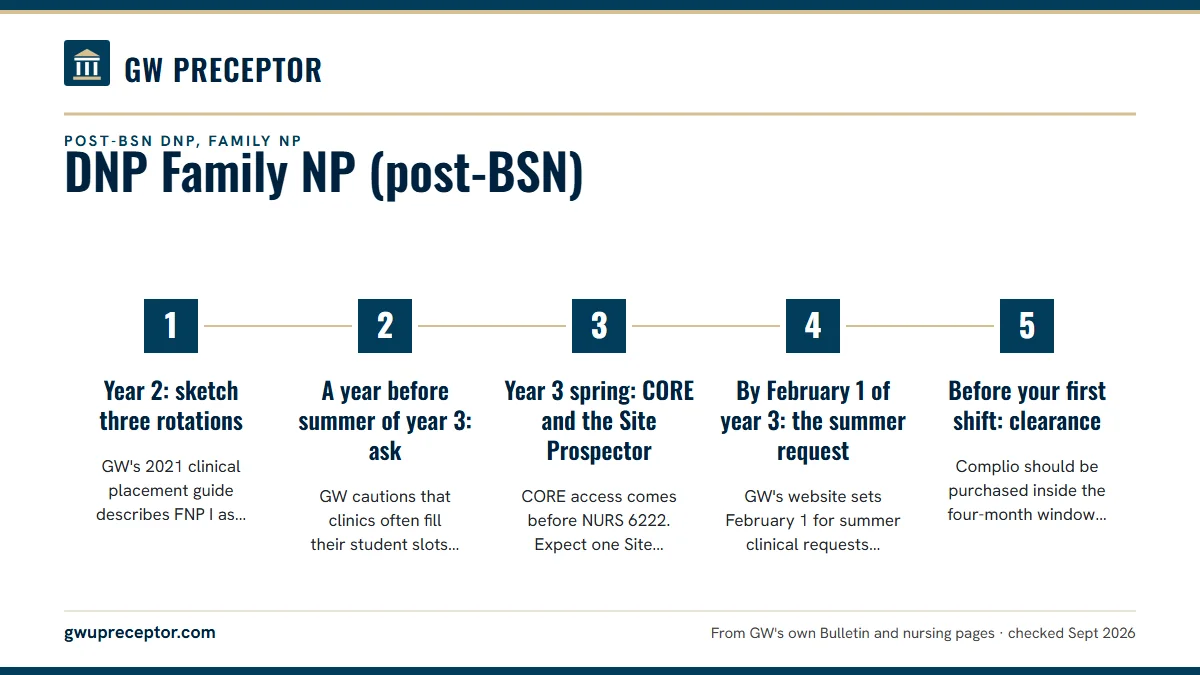
Two years of coursework before the first rotation feels like plenty of time. It is, if you use it. Here is the order that works against GW's own dates.
- Year 2: sketch three rotationsGW's 2021 clinical placement guide describes FNP I as internal medicine with no pediatric patients, FNP II as OB/GYN plus pediatrics, and FNP III as family practice, with room for a single specialty site capped at 50 hours. Current rules may differ; the FNP clinical courses page has the detail.
- A year before summer of year 3: askGW cautions that clinics often fill their student slots over a year out. Approach internal medicine, women's health and pediatric clinicians well before any request is due.
- Year 3 spring: CORE and the Site ProspectorCORE access comes before
NURS 6222. Expect one Site Prospector entry for every preceptor-site pairing in every rotation and term, each carrying that clinician's license plus a bio or CV. - By February 1 of year 3: the summer requestGW's website sets February 1 for summer clinical requests. CORE's Document Library holds the dates for your term, and the request deadlines page explains why they can differ.
- Before your first shift: clearanceComplio should be purchased inside the four-month window before your clinical term, and no hours count until the Clinical Placement Team sends your clearance.
Why DNP FNP students choose our placement desk
Your doctorate gives you something MSN students rarely get: two full years of warning. We turn that lead time into a finished plan. Your placement advisor maps all three FNP rotations as one sequence, internal medicine, then women's health and pediatrics, then family practice, and lines up preceptors near your home who fit each course.
For every rotation we build the Site Prospector package: license, bio or CV, the person who signs the site's agreement, and a short case for why the setting fits the course, all checked against GW's rules. Your program director at GW still makes the call, and our work is to put a complete, rule-ready package in front of them on the first pass. If a preceptor steps back in year four, we go straight to work on a replacement.
Give us your cohort year and home city in the form below, and your advisor will set the search dates against your plan of study.
Questions GW students ask
Can I take GW's DNP FNP full-time?
GW posts only a part-time plan of study for its post-BSN DNP tracks, running 11 semesters from fall of year one through spring of year four. If a faster pace matters to you, ask admissions before you apply whether any other schedule exists; the published plans show only the part-time path.
Do the 500 indirect DNP hours need a preceptor?
Not according to GW's DNP FNP page, which asks for at least 600 hours with an approved preceptor and says program coursework covers the other 500. The Bulletin labels that second block indirect DNP practice hours. GW leaves their split among the four project courses unstated, so each project syllabus tells you your share.
Can I live outside DC, Maryland and Virginia during the FNP doctorate?
In most states, yes. You study online and rotate near home, licensed as an RN wherever you log hours. The exceptions sit on GW's State Authorizations page: Wisconsin, North Dakota, Mississippi, Louisiana and Alabama are closed to online applicants, New Yorkers must rotate outside New York, and Arizona is left out of every DNP. Read state authorizations.
Where are the FNP OSCEs held?
For 2026-27, GW's NP events dashboard sends FNP and AGPCNP students to Ross Hall in Foggy Bottom, with sessions on October 5 and 6, 2026 and on February 27 and 28, 2027. That differs from GW's FAQ, which names VSTC in Ashburn as the usual testing site. Your own year's dates will be on the dashboard; the OSCE guide has more.
Is the DNP FNP the same clinical work as GW's MSN FNP?
The precepted part matches: the same three courses and the same 600 hours in a 120, 240 and 240 split. What differs is the timing and what surrounds it. An MSN student can be in NURS 6230 as early as semester 3, or in semester 5 or 6 on a part-time plan, while DNP students reach it in semester 9 and carry doctoral courses and the project as well.
Related pages
Last checked 2026-09-24
We check these pages against GW's Bulletin and GW Nursing's own program and clinical pages. Your course, CORE and GW's Clinical Placement Team have the final word.
GW asks you to find your own site and preceptor. Hand that search to us.
Tell us your GW program, where you live and which clinical course is next. We find preceptors who fit the course and prepare the license, bio and site details GW's review asks for, so your Site Prospector goes in complete.
- Preceptors matched to the course: family practice for
NURS 6230toNURS 6232, older-adult primary care for AGPCNP, psychiatric care for PMHNP - License, bio or CV and the site's agreement signatory ready for your CORE submission
- Close to home, in DC, Maryland, Virginia or wherever you live and hold your RN license
Start your placement plan
Your program, city and next clinical term is all we need to begin.