GW DNP practice hours: direct, indirect and carried over
GW's post-BSN DNP nurse practitioner tracks require 600 direct clinical hours with a preceptor plus 500 indirect DNP practice hours, according to the Bulletin 2026-27. GW's program pages call the same thing 1,100 hours, and the previous Bulletin printed a third version. The post-MSN DNP works from a 1,000-hour total, and most students bring 500 of those from their master's program.
Get your placement plan
Tell us your GW program and where you live. A placement advisor replies with the preceptor and site options that fit your GW course.
Three versions of the post-BSN DNP total
The four post-BSN DNP tracks (FNP, AGPCNP, AGACNP and PMHNP) are described by three GW sources that do not quite line up. Read them together before you plan a single term.
| GW source | What it says | Direct / indirect |
|---|---|---|
| Bulletin 2026-27, GW's newest catalog | Students complete "600 direct clinical hours and 500 indirect" DNP practice hours, in all four NP tracks | 600 / 500 |
| GW Nursing DNP program pages, 2026 | "a minimum of 1,100 post-baccalaureate practice hours," at least 600 of them precepted, with coursework covering the other 500 | 600 / 500 |
| Bulletin 2025-26, the previous catalog | A minimum of 1,000 practice hours for FNP, AGPCNP and AGACNP, at least 500 direct and 500 indirect; PMHNP already read 600 + 500 | 500 / 500 |
Added up, the two newer sources agree: 600 direct plus 500 indirect is the web's 1,100. The outlier is the 2025-26 Bulletin, whose 500 direct hours never matched clinical courses that sum to 600. Your program director confirms which figure governs your entering class, so ask before your first clinical term and keep the reply.
The 600 direct hours use the MSN's clinical courses
Direct hours are precepted patient-care hours, earned in the same courses MSN students take: NURS 6230, NURS 6231 and NURS 6232 for FNP; NURS 6224, NURS 6225 and NURS 6229 for AGPCNP; NURS 6235, NURS 6236 and NURS 6237 for AGACNP; and five 120-hour courses for PMHNP. The course-by-course split is laid out in GW's 600 clinical hours.
What differs is timing. GW's November 2024 plans run the post-BSN DNP part-time over 11 semesters, and the precepted courses come late. NURS 6230, NURS 6224 and NURS 6235 start in the summer of year three, semester 9, while PMHNP's NURS 6245 starts in the fall of year three, semester 7. That gives you well over a year to line up preceptors if you start early; your first clinical semester lists every plan.
AGACNP DNP students have one extra condition from the Bulletin: they must live in Maryland, Northern Virginia or DC while taking the three acute care courses.
Where the 500 indirect hours come from
Indirect hours are DNP practice hours rather than precepted patient care. GW's DNP pages say the program supplies them: "We provide coursework within the program for the remaining 500 hours." In the Bulletin's course lists for all four post-BSN tracks, that work sits in the DNP project sequence, four courses of 3 credits each.
NURS 8489DNP Project Scholarly InquiryNURS 8490DNP Project PlanningNURS 8491DNP Project ImplementationNURS 8492DNP Project Evaluation and Dissemination
GW does not publish how the 500 hours are divided across these four courses or how they are recorded; the project course faculty set that out when you reach them. What each course asks of you is covered on the DNP project courses page.
Post-MSN DNP: 1,000 hours, 500 carried in
The post-MSN DNPs (Nursing Practice, which is admitting, plus Executive Leadership and Health Policy, which are not taking Fall 2026 applicants) work from one total. The Bulletin 2026-27 expects a minimum of 1,000 post-baccalaureate practice hours and explains that most advanced practice nurses arrive with 500 from their MSN, with the remaining 500 built into the DNP curriculum. The program pages say it more briefly: 500 pre-DNP hours required, coursework for the rest.
In the Bulletin's Nursing Practice course list, the in-program hours sit with the project courses NURS 8490, NURS 8491 and NURS 8492. GW does not publish how it verifies the hours you bring in, or who arranges a practice setting for the in-program hours. The named contact on the Nursing Practice page is the Associate Dean for Graduate Clinical Programs, and your program director is the other person to ask. The program as a whole is covered on the DNP Nursing Practice page.
The DNP Health Policy practicum: 75 hours
DNP Health Policy adds one more requirement: a 75-hour Health Policy Practicum spent collaborating with a policy expert in a professional organization, a government agency, an advocacy group or a similar body. GW's program page does not give the practicum's course number, and it does not say whether the 75 hours sit inside the 1,000-hour total or on top of it, which is worth asking.
Because the program is not admitting for Fall 2026, the practicum matters to students already enrolled. It calls for a different kind of host from an NP rotation: an organization doing real policy work and a mentor inside it, rather than a clinic and a licensed prescriber. Confirm with your faculty what the host and mentor must provide before you approach anyone, so the arrangement is approved the first time.
Planning DNP hours without losing a term
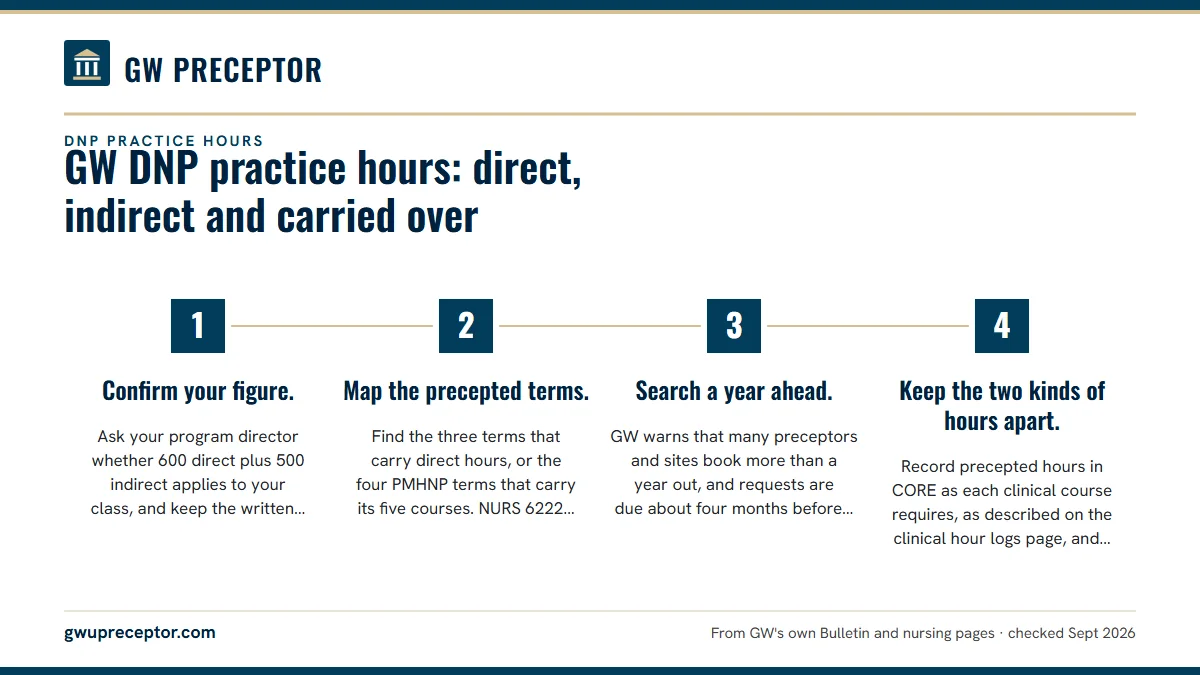
- Confirm your figure.Ask your program director whether 600 direct plus 500 indirect applies to your class, and keep the written answer with your plan of study.
- Map the precepted terms.Find the three terms that carry direct hours, or the four PMHNP terms that carry its five courses.
NURS 6222sits in the term just before the first one. - Search a year ahead.GW warns that many preceptors and sites book more than a year out, and requests are due about four months before each term; the dates are on the request deadlines page.
- Keep the two kinds of hours apart.Record precepted hours in CORE as each clinical course requires, as described on the clinical hour logs page, and follow your project faculty's method for indirect hours.
Why DNP students choose us for their clinical years
The long runway in a post-BSN DNP is easy to waste and hard to recover once it is gone. We put it to work: we search near home for preceptors who fit each of your clinical courses, confirm they can carry both the 120-hour and the 240-hour terms, and prepare the license, bio or CV and site details each Site Prospector submission needs.
Your program director decides on every placement, and the request that reaches them is complete from the start. If a preceptor drops before or during a course, we begin on a replacement straight away. Read the DNP FNP overview or tell us your plan of study through the form below.
Questions GW students ask
Do I need a preceptor for GW's 500 indirect DNP hours?
GW attaches its preceptor requirement to the 600 direct clinical hours. The 500 indirect hours are described as coursework inside the program, centered on the DNP project courses. Whether your project also needs a partner organization or site mentor is set in those courses, so raise it with your project faculty well before NURS 8490 begins.
Does the post-MSN DNP include NP clinical courses?
The Bulletin 2026-27 course list for Nursing Practice contains no NP clinical courses of the NURS 6230 kind. Its in-program practice hours sit with the DNP project sequence. The 600 precepted NP hours belong to the MSN, the post-BSN DNP and the post-master's certificate tracks.
How long do I have to finish GW's DNP?
The Bulletin 2026-27 allows 16 semesters for the post-BSN DNP and 13 for the post-MSN DNP. GW's posted plans are shorter: 11 part-time semesters for the post-BSN NP tracks, and 5 full-time or 8 part-time semesters for Nursing Practice. A lost clinical term eats into that margin quickly.
Do DNP students attend CLASI and OSCEs like MSN students?
Yes. Post-BSN DNP students follow the same on-campus pattern as the MSN in their track: CLASI with NURS 6222, then OSCEs or AGACNP simulation events during clinical courses. PMHNP students attend a virtual CLASI, and from Fall 2027 those in NURS 6248 attend an on-campus simulation event.
What if my MSN had fewer than 500 practice hours?
GW's pages assume most advanced practice nurses bring 500 hours from the MSN, but they do not say how a shortfall is handled. Ask the program director or the Associate Dean for Graduate Clinical Programs before you enroll, with your MSN transcript and any record of your practicum hours in hand.
Related pages
Last checked 2026-09-24
We check these pages against GW's Bulletin and GW Nursing's own program and clinical pages. Your course, CORE and GW's Clinical Placement Team have the final word.
GW asks you to find your own site and preceptor. Hand that search to us.
Tell us your GW program, where you live and which clinical course is next. We find preceptors who fit the course and prepare the license, bio and site details GW's review asks for, so your Site Prospector goes in complete.
- Preceptors matched to the course: family practice for
NURS 6230toNURS 6232, older-adult primary care for AGPCNP, psychiatric care for PMHNP - License, bio or CV and the site's agreement signatory ready for your CORE submission
- Close to home, in DC, Maryland, Virginia or wherever you live and hold your RN license
Start your placement plan
Your program, city and next clinical term is all we need to begin.