Which clinical settings fit each GW course
GW's 2021 clinical placement guide names the kind of setting each NP clinical course expects: internal medicine without children for FNP 1, OB/GYN and pediatrics for FNP 2, long-term care hours in AGPCNP 3, critical care later in the acute care sequence. GW still hosts that guide but no longer links it, so read every row below as 2021 guidance and confirm it in your current course before you commit to a site.
Get your placement plan
Tell us your GW program and where you live. A placement advisor replies with the preceptor and site options that fit your GW course.
Where these settings come from
Everything on this page traces to one document: GW's Graduate Clinical Placement Guide, created in 2020 and last modified in February 2021. GW linked it from its Compliance and Clinical page in 2021, later stopped linking it, and still hosts the file. Nothing newer that GW publishes lists settings course by course, so it remains the most detailed public account of what each rotation is for.
It is also several years old. Course content, faculty preferences and site rules may have shifted since, and GW has not confirmed these rules as current. Use the table to aim your search, then check the setting against your current syllabus, your Clinical Experience Faculty or your program director before a Site Prospector submission goes in. The program director reviews every site for fit with the course, whatever any guide says.
Settings by course, per GW's 2021 guide
The guide names course levels (FNP 1, AGACNP 2 and so on); the course numbers are matched to them by title, and the hours come from GW's current program pages.
| Course (2021 guide level) | Hours | Setting in GW's 2021 guide |
|---|---|---|
NURS 6230 (FNP 1) | 120 | Internal medicine, with no pediatric patients |
NURS 6231 (FNP 2) | 240 | OB/GYN, about 60 OB and 60 GYN hours, plus pediatrics |
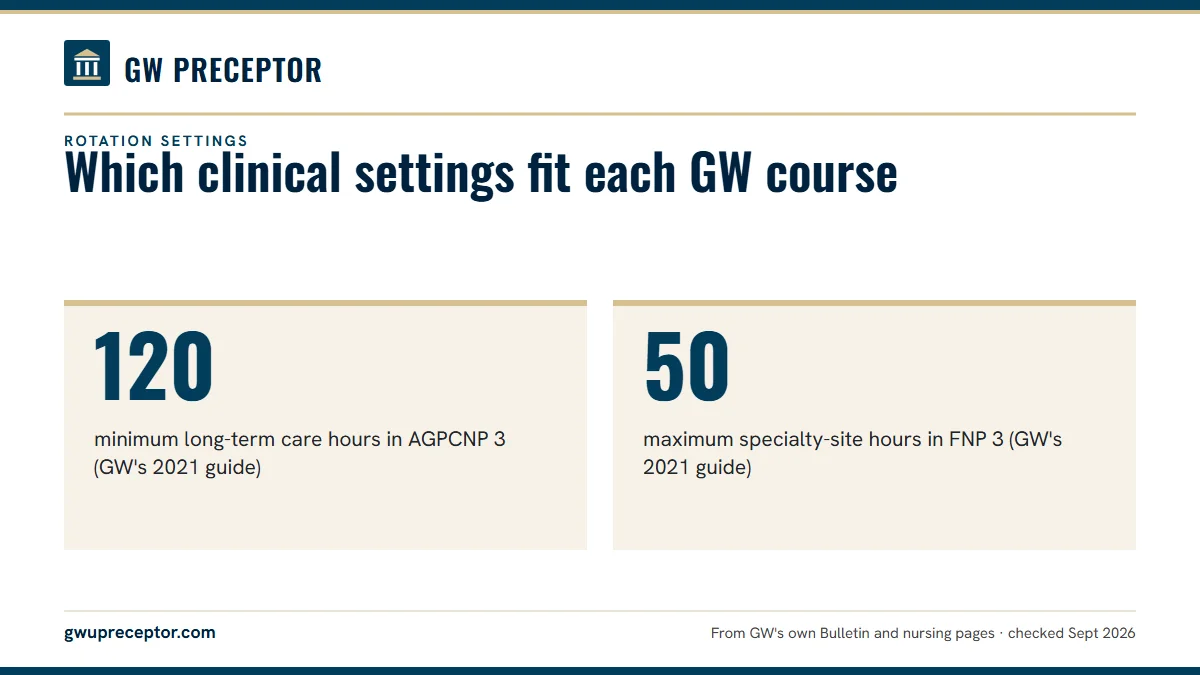
NURS 6232 (FNP 3) | 240 | Family practice; one specialty site of up to 50 hours |
NURS 6224 (AGPCNP 1) | 120 | Excludes urgent care, ED fast track, long-term care and nursing homes |
NURS 6225 (AGPCNP 2) | 240 | Adult, adolescent and women's health; up to 100 outpatient specialty hours |
NURS 6229 (AGPCNP 3) | 240 | At least 120 hours in nursing homes or long-term care; up to 100 palliative or hospice hours |
NURS 6235 (AGACNP 1) | 120 | Hospital medicine, telemetry or intermediate care |
NURS 6236 (AGACNP 2) | 240 | Critical care; up to 100 specialty hours |
NURS 6237 (AGACNP 3) | 240 | Critical care, long-term care, rehabilitation or geriatric settings |
NURS 6244 to NURS 6248 (PMHNP) | 120 each | Listed course by course in the guide; NURS 6248 needs a PMHNP or CNS preceptor |
Every row is 2021 guidance from GW's clinical placement guide. Confirm the setting in your current course before you ask a preceptor to commit.
Reading the FNP sequence
The FNP courses widen from adults to the whole lifespan. FNP 1 keeps you in internal medicine with no pediatric patients, so the first 120 hours can focus on adult history, examination and management. FNP 2 broadens the lens to roughly 60 OB and 60 GYN hours plus pediatrics, all inside one 240-hour course. FNP 3 returns to family practice, the setting the degree is named for, with room for a single specialty site of up to 50 hours.
FNP 2 is the course most likely to need two preceptors, because few single practices offer obstetrics, gynecology and pediatrics together. Two preceptors means two Site Prospector submissions, and two affiliation agreements if neither site already has one with GW. Begin that search first. Each course is covered in the FNP clinical courses guide.
Reading the AGPCNP sequence
AGPCNP 1 is defined mostly by what it leaves out: urgent care, ED fast track, long-term care and nursing homes are all off the table in the first clinical semester. AGPCNP 2 covers adult, adolescent and women's health and allows up to 100 hours in outpatient specialty clinics. AGPCNP 3 turns to older and frail adults, with at least 120 of its 240 hours in a nursing home or long-term care setting and up to 100 in palliative care or hospice.
The long-term care block deserves an early start. A nursing home with an NP or physician able to precept is a different search from a primary care office, and like any site it needs a completed agreement with GW before your hours can start. The AGPCNP clinical courses guide takes each course in turn.
Reading the AGACNP sequence
The acute care courses rise in intensity. AGACNP 1 sits in hospital medicine, telemetry or intermediate care. AGACNP 2 moves into critical care, with up to 100 hours allowed in a specialty. AGACNP 3 accepts critical care, long-term care, rehabilitation or geriatric settings, in line with its focus on complex and chronic disease in adolescents through older adults.
Two conditions sit on top of the settings. AGACNP clinicals run only in Washington, DC, Maryland or Northern Virginia, and GW's program director is closely involved in arranging them, although GW's own sources describe that role in different ways. The AGACNP placements page covers both conditions, and the AGACNP clinical courses page covers the courses and their simulation events.
PMHNP: settings course by course
The 2021 guide lists PMHNP settings separately for each course instead of giving one rule for the track. The course titles show where each rotation leans: NURS 6244 works with families and groups, NURS 6245 centers on diagnostic assessment, NURS 6246 on advanced practice with individuals, NURS 6247 on population-based practice, and NURS 6248 on integrated application of the whole role.
One rule from the guide is firm enough to plan around now: NURS 6248 must be precepted by a PMHNP or a CNS. For the other four courses, check the setting list in your current course materials before you commit, and remember that each course carries 120 hours. See PMHNP clinical courses for the sequence and preceptor requirements for credentials.
Why GW students choose us to match setting to course
A preceptor can be excellent and still be wrong for the course: a pediatric-heavy practice in FNP 1, an urgent care in AGPCNP 1, a clinic with no obstetrics in FNP 2. We read your GW course first, search for preceptors whose setting fits it, and flag anything the 2021 guide would rule out before your program director ever sees the request.
Each Site Prospector submission we prepare describes the setting plainly, so the course fit is quick to confirm, and if a site falls through we replace it with one suited to the same course. How the submission works is on the Site Prospector page, and the hours behind every row are on clinical hours by program.
Questions GW students ask
Can my FNP 1 rotation be in a family practice that sees children?
GW's 2021 guide places FNP 1 in internal medicine without pediatric patients, and a mixed family practice is a closer match for FNP 3. If a family practice is your only option for the first course, ask your CEF or program director before you submit it, since the program director decides whether a site fits the course.
Does urgent care count for any GW NP course?
The 2021 guide mentions urgent care only once, as a setting excluded from the first AGPCNP course. It says nothing either way about urgent care for the other courses, so using one for a later rotation is a question for your course faculty and program director before the request goes into CORE.
How many specialty hours can a GW NP course include?
Under the 2021 guide: one specialty site of up to 50 hours in FNP 3, up to 100 outpatient specialty hours in AGPCNP 2, up to 100 specialty hours in AGACNP 2, and up to 100 palliative or hospice hours in AGPCNP 3. The rest of each course sits in its core setting.
Do these settings apply to the DNP and certificate tracks?
The post-BSN DNP and the AGPCNP and AGACNP certificates use the same clinical course numbers as the MSN, so the same 2021 guidance points the way, with the same need to confirm it. The FNP certificate uses a different course structure, NURS 6227 with NURS 6250 to NURS 6252, which the guide's FNP levels do not map onto directly.
Does GW describe settings for midwifery or leadership practicums?
Only in general terms. GW's midwifery network emphasizes birth centers and home birth across 840 immersion hours. The leadership practicums take place in a setting agreed between student and instructor, with a preceptor holding a master's degree or higher, and the second practicum must use a different preceptor and site from the first.
Related pages
Last checked 2026-09-24
We check these pages against GW's Bulletin and GW Nursing's own program and clinical pages. Your course, CORE and GW's Clinical Placement Team have the final word.
GW asks you to find your own site and preceptor. Hand that search to us.
Tell us your GW program, where you live and which clinical course is next. We find preceptors who fit the course and prepare the license, bio and site details GW's review asks for, so your Site Prospector goes in complete.
- Preceptors matched to the course: family practice for
NURS 6230toNURS 6232, older-adult primary care for AGPCNP, psychiatric care for PMHNP - License, bio or CV and the site's agreement signatory ready for your CORE submission
- Close to home, in DC, Maryland, Virginia or wherever you live and hold your RN license
Start your placement plan
Your program, city and next clinical term is all we need to begin.