GW's post-BSN DNP in Adult-Gerontology Acute Care: residency, placement and the clinical years
The acute care doctorate is the one GW nurse practitioner specialty that sits outside the own-preceptor rule, and it carries a condition the other tracks lack: you must live in Maryland, Northern Virginia or DC while you take NURS 6235, NURS 6236 and NURS 6237. GW's program director is closely involved in your placements, though GW's pages describe that role in more than one way. Here is what each source says and how to prepare.
Prepare for your acute care rotations
Tell us your start year and where in DC, Maryland or Northern Virginia you live. Your placement advisor readies acute care preceptor options.
Where you must live, and when
The Bulletin 2026-27 is specific: DNP applicants "must live in Maryland, Northern Virginia, or the District of Columbia while taking the clinical courses NURS 6235, NURS 6236 and NURS 6237." The DNP program page makes the same point from the other side, saying the option is available only to applicants who can do their clinical rotations in those areas.
GW's program pages add a residency test for every AGACNP option: you must be a resident of DC, Maryland or Virginia. Notice the gap between the two rules. Virginia residency gets you in the door, but the clinical rule names Northern Virginia, so a Virginian based far from the Washington region should plan to live within reach of DC, Maryland or Northern Virginia sites for the three clinical terms.
Two more state rules apply. GW's State Authorizations page excludes Washington-state applicants from all AGACNP options and excludes Arizona from every DNP. The AGACNP placements guide covers the regional rule across the MSN, the DNP and the certificate.
Who arranges the placements: four GW statements
GW's own pages give four versions of the program director's role. All of them agree the clinicals happen in DC, Maryland or Northern Virginia; they differ on who does the finding.
- DNP AGACNP program page, introduction: "Clinical placements will be arranged by the program director and will take place in Northern Virginia, Maryland or Washington, D.C."
- Bulletin 2026-27: placements are selected jointly by the student and the program director.
- Clinical Rotations page: acute care students are the named exception to the rule that graduate students secure their own site and preceptor.
- The Clinical Placement tab on the same DNP page: GW's standard line encouraging you to find your own preceptor.
Read together, the program director leads and may ask for your input. The practical step is to ask your program director early what they want from you: hospitals where you have worked, a clinician you already know, or nothing until an assignment arrives. GW's 2026 Clinical Placement Team structure includes a program associate whose portfolio covers Acute Care, and the team handles the placement paperwork once a site is chosen.
Critical care background and ACLS
GW's DNP acute care page asks for at least one year of experience in a critical care setting before you start. The Bulletin's MSN version of the same specialty spells out what counts, ICU, trauma, CCU or emergency department work within the past five years, and the program director can confirm whether the doctoral option reads it the same way.
The requirement follows the clinical content. GW's 2021 clinical placement guide described AGACNP I as hospital medicine, telemetry or intermediate care, AGACNP II as critical care with up to 100 specialty hours, and AGACNP III as critical care, long-term care, rehabilitation or geriatric settings. Current settings may differ, so confirm them in your course and see the AGACNP clinical courses page.
On the compliance side, acute care students upload current ACLS from the American Heart Association or the American Red Cross to Complio, on top of the BLS card every graduate student needs.
The plan: 11 semesters, clinicals in the last three
| Semester | Term | What happens |
|---|---|---|
| 1 | Year 1 fall | Program start; fall entry only |
| 8 | Year 3 spring | NURS 6222 with CLASI, the term before clinicals |
| 9 | Year 3 summer | NURS 6235 Introduction to Practice, 120 hours |
| 10 | Year 4 fall | NURS 6236 Complex and Acute Illness, 240 hours |
| 11 | Year 4 spring | NURS 6237 Complex and Chronic Disease Management, 240 hours |
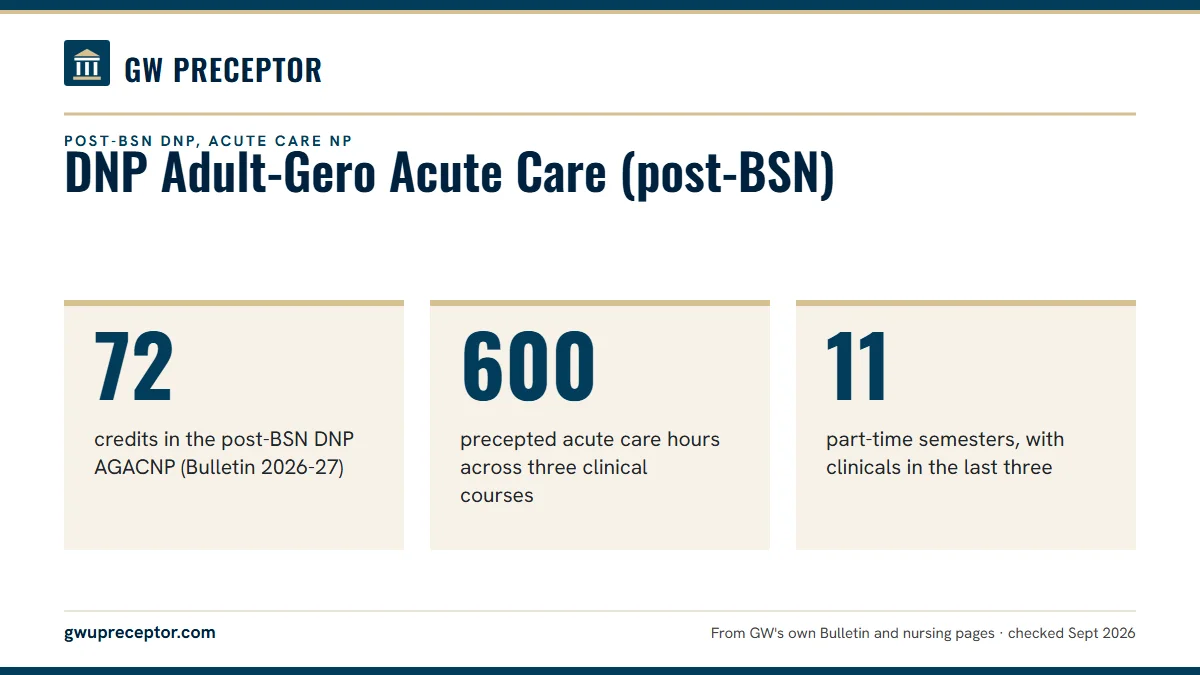
The 72 credits combine the shared advanced practice courses, eight doctoral courses, the four-course DNP project from NURS 8489 to NURS 8492, and the three acute care clinicals. The doctoral hour rule matches every post-BSN track: 600 direct and 500 indirect hours in the Bulletin 2026-27, or 1,100 in total on GW's website. The DNP practice hours page explains the difference.
Semester 9 is the first clinical term, so the residency rule applies from summer of year three through spring of year four. If you plan to move into the region, that is the window that counts.
Simulation events on campus
Where the primary care tracks list OSCEs in two clinical courses, GW's AGACNP pages list clinical simulation events in all three: while enrolled in NURS 6235, NURS 6236 and NURS 6237, you are required to come to campus. The Bulletin describes several on-campus experiences tied to DNP coursework, clinical skills development and patient assessment. CLASI, during NURS 6222, comes first, and the end-of-program skills assessment applies to every GW nurse practitioner student.
Dates go up on GW's NP On-Campus Events Dashboard, which says specific schedules appear about six months before each event. Build those days into your preceptor's calendar when the rotation is set, since they fall inside clinical terms. The NURS 6222 and CLASI page covers the first on-campus requirement.
How we support acute care doctoral students
Because your program director is closely involved in AGACNP placements, our work fits around that role. Your placement advisor identifies acute care NPs and physicians at hospitals in DC, Maryland and Northern Virginia who are open to taking a GW student, and checks each against the course: hospital medicine for the first term, critical care for the second.
When your program director asks for options, or a planned site falls through, you have complete candidates ready: license, bio or CV, unit and signatory details, prepared the way GW's review expects. GW's program director gives the final approval; we make sure what reaches them is complete and fits the rules the first time.
We also help with the regional details, such as planning the RN licenses GW recommends for DC-area rotations. Start with the form below, or read our guides to Northern Virginia preceptors and Maryland preceptors.
Questions GW students ask
Can I apply to GW's DNP AGACNP if I live in southern Virginia?
GW's program pages accept Virginia residents for its AGACNP options, but the Bulletin requires DNP students to live in Maryland, Northern Virginia or DC while taking NURS 6235 through NURS 6237. If you live elsewhere in Virginia, plan to relocate within reach of those sites for the three clinical terms, and confirm the details with the program director before you apply.
Which RN licenses do I need for DC-area acute care rotations?
GW requires an RN license in every state where you complete clinical hours. Its 2026 CORE workshop recommends that DC-area students hold a Maryland or Virginia multistate license and a DC license as well, so a rotation on either side of the District line stays covered. The RN license page walks through it.
Do DNP AGACNP students take OSCEs?
GW's FAQ says nurse practitioner students take OSCEs during their second clinical course, while the AGACNP program pages describe required simulation events on campus during all three acute care courses. Treat the simulation events as firm commitments, check the NP On-Campus Events Dashboard each term, and ask your course faculty how the OSCE rule applies to your cohort.
Is the DNP AGACNP admitting for Fall 2026?
GW's deadlines page listed the post-BSN DNP AGACNP for Fall 2026, while the program page's June 2026 version still showed Fall 2025 dates. The track admits in the fall only. Check the live admissions page for current dates before you plan an application, and see our DC preceptor guide if you live in the District.
What happens if my acute care placement falls through?
GW's placement model answers a failed placement with ongoing intervention and support and a return to the identification step. GW's 2021 clinical placement guide adds that the Clinical Placement Team contacts you if a site cancels, and that you should talk with your Clinical Experience Faculty and program director about the course. Vetted alternatives shorten that gap.
Related pages
Last checked 2026-09-24
We check these pages against GW's Bulletin and GW Nursing's own program and clinical pages. Your course, CORE and GW's Clinical Placement Team have the final word.
GW asks you to find your own site and preceptor. Hand that search to us.
Tell us your GW program, where you live and which clinical course is next. We find preceptors who fit the course and prepare the license, bio and site details GW's review asks for, so your Site Prospector goes in complete.
- Preceptors matched to the course: family practice for
NURS 6230toNURS 6232, older-adult primary care for AGPCNP, psychiatric care for PMHNP - License, bio or CV and the site's agreement signatory ready for your CORE submission
- Close to home, in DC, Maryland, Virginia or wherever you live and hold your RN license
Start your placement plan
Your program, city and next clinical term is all we need to begin.