The preceptor paperwork GW asks for: biography, guide and evaluations
Your preceptor's paperwork at GW comes in three parts. Before approval, GW needs the preceptor's details, either on its Clinical Preceptor Biography form or as a CV with the license information. Before you start, the preceptor signs the last page of GW's preceptor guide and you upload it to CORE. During the rotation, CORE emails the preceptor a mid-semester and a final evaluation.
Get your placement plan
Tell us your GW program and where you live. A placement advisor replies with the preceptor and site options that fit your GW course.
Three documents, three moments
Each piece does a different job. The biography lets GW's reviewers confirm the preceptor meets its rules, the guide sign-off shows the preceptor has read what GW expects of them, and the evaluations record how the rotation actually went.
| Document | When it is needed | Where it goes |
|---|---|---|
| Clinical Preceptor Biography form, or a CV plus license | With your Site Prospector submission, ahead of program director review | Attached in CORE |
| Signed last page of the preceptor guide | Before the rotation begins | Uploaded into CORE by you |
| Mid-semester and final evaluations | Partway through and at the end of the rotation | Emailed to the preceptor from CORE, then visible in CORE |
Preceptor documentation is also one of the four items GW's 2021 clinical placement guide requires before a student is cleared, so a gap here holds up the whole rotation, not just one form. The clearance page lists the other three items.
What the Clinical Preceptor Biography form asks
GW Nursing's Forms page lists it as Clinical Preceptor Biography, and the copy GW hosts carries a 2018 file date. It collects:
- The preceptor's name, email and a contact number
- Undergraduate and graduate degrees
- Licensure: the state, the license type, the number and the expiration date
- Specialty certifications
- The three most recent employers
- Areas of expertise
- The preceptor's signature
Fill every gap before it leaves your hands. A blank expiration date or a missing graduate degree is exactly the kind of detail that sends a request back, and the employer history is how a reviewer sees the two years of advanced practice described on the preceptor requirements page.
The form's own instructions return it to the Clinical Placement Team at sonclinical@gwu.edu. GW's 2026 CORE workshop, meanwhile, has students attach the biography or CV to the submission in CORE. If the two instructions leave you unsure for your term, ask the team which route they want.
Biography form or CV?
GW accepts either. Its 2021 clinical placement guide counts the biography form, or a CV or resume with the license number, as preceptor documentation. The 2026 CORE workshop says the same thing more briefly, asking students to attach the preceptor's license and bio or CV.
A CV suits clinicians who already keep one up to date. The biography form works better when a CV is old, leaves out license numbers, or hides the dates of advanced practice among other roles. Whichever you send, the reviewer should be able to find four facts without hunting: the credential, the license and its expiration, the years in the advanced role, and the specialty.
When a preceptor changes mid-term, the paperwork starts over. The new person needs their own Site Prospector submission, and the 2021 guide says the placement team must verify them before you work together.
The preceptor guide sign-off
GW keeps a preceptor guide for the clinicians who supervise its students. It is not posted publicly, so the current copy comes through GW's clinical process; if you do not have it, ask your Clinical Experience Faculty or the Clinical Placement Team.
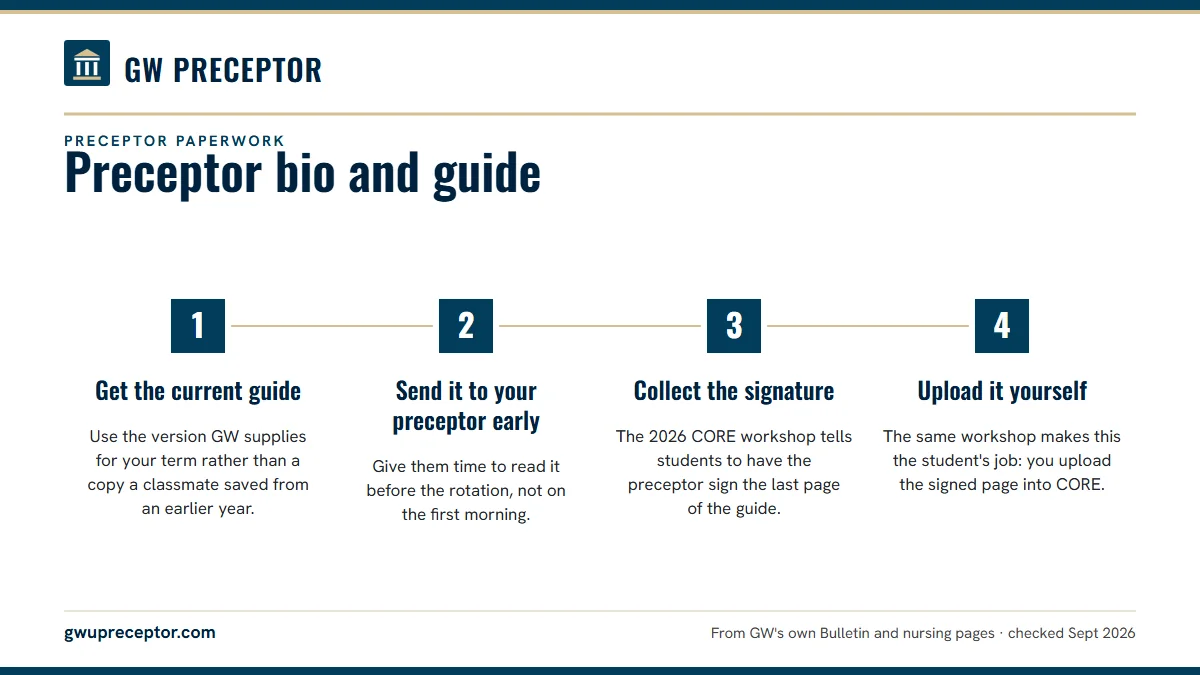
- Get the current guideUse the version GW supplies for your term rather than a copy a classmate saved from an earlier year.
- Send it to your preceptor earlyGive them time to read it before the rotation, not on the first morning.
- Collect the signatureThe 2026 CORE workshop tells students to have the preceptor sign the last page of the guide.
- Upload it yourselfThe same workshop makes this the student's job: you upload the signed page into CORE.
GW publishes nothing further about preceptor orientation or training beyond the guide itself. If a preceptor asks what else GW expects, pass the question to the placement team rather than answering from memory.
Evaluations sent from CORE
GW's 2021 guide describes two preceptor evaluations in each rotation, one at mid-semester and one at the end. CORE emails each to the preceptor, the preceptor goes over it with you before submitting it electronically, and the completed evaluation then appears in CORE.
The weak point is the email address. The 2026 CORE workshop reminds students to give the correct address for preceptor evaluations when they submit the site, because the request goes wherever you point it. Use the address your preceptor reads during the workday, and confirm it with them in person. If two preceptors share your rotation, each needs their own correct address on their own submission.
Evaluations sit alongside faculty oversight and site visits. The evaluations and site visits page explains how the two fit together over a term.
Paperwork slips that cost students time
- A license that expires during the term with no renewal on file
- A biography form left unsigned, or signed with sections still blank
- An evaluation email pointed at a shared front-desk inbox
- The guide's last page signed but never uploaded to CORE
- Two preceptors sharing a rotation, but only one submission and one set of documents
- A replacement preceptor who starts precepting before the placement team has verified them
Most of these take minutes to fix if you catch them before review and far longer once a reviewer has sent the file back. Keep a copy of every document you send, check CORE after each upload to confirm it landed where you expected, and set a reminder for any license or certification that renews during the term.
Why GW students hand this part to us
Chasing a busy clinician for a form is where many placements stall. When we match you with a preceptor, we collect a complete biography or current CV, confirm the license and its expiration with the state board, and check the email address CORE should use for evaluations. We brief the preceptor on what GW's process asks of them, including the guide sign-off, so the signed page is ready for you to upload.
You get a preceptor file that answers the reviewer's questions at a glance, and a placement desk that stays in touch with the preceptor through the term. GW's reviewers make the decisions; we make sure the paperwork in front of them is complete. See how it works or send your course details through the contact page.
Questions GW students ask
Where does my preceptor send GW's biography form?
The form itself names the Clinical Placement Team's inbox as its return address. GW's 2026 CORE workshop has students attach the preceptor's biography or CV, along with the license, to the Site Prospector submission in CORE. If you are unsure which route GW wants for your term, ask the placement team and follow their answer.
Can my preceptor send a resume instead of GW's form?
Yes. GW's 2021 clinical placement guide accepts a CV or resume plus the license number in place of the biography form, and the 2026 CORE workshop asks for the license and a bio or CV. Make sure the resume shows the credential, the license expiration and the dates of advanced practice clearly.
Who uploads the signed preceptor guide page?
You do. GW's 2026 CORE workshop tells students to have the preceptor sign the last page of the preceptor guide and then upload it into CORE themselves. Keep your own copy of the signed page, since a later rotation with the same preceptor may call for it again.
What if my preceptor never receives the evaluation email?
Check the address you entered in your Site Prospector submission first, since CORE sends the request wherever you pointed it. Then ask your Clinical Experience Faculty or the placement team how to have it sent again. GW's 2021 guide expects each evaluation to be discussed with you before it is submitted, so allow time for that conversation.
Does GW train or orient its preceptors?
The only preceptor material GW describes publicly is the preceptor guide, which the preceptor signs and you upload. For preceptors, GW's Become a Preceptor page lists access to the Himmelfarb Health Sciences Library, a chance to guest lecture at GW Nursing and an invitation to collaborate with other preceptors.
Related pages
Last checked 2026-09-24
We check these pages against GW's Bulletin and GW Nursing's own program and clinical pages. Your course, CORE and GW's Clinical Placement Team have the final word.
GW asks you to find your own site and preceptor. Hand that search to us.
Tell us your GW program, where you live and which clinical course is next. We find preceptors who fit the course and prepare the license, bio and site details GW's review asks for, so your Site Prospector goes in complete.
- Preceptors matched to the course: family practice for
NURS 6230toNURS 6232, older-adult primary care for AGPCNP, psychiatric care for PMHNP - License, bio or CV and the site's agreement signatory ready for your CORE submission
- Close to home, in DC, Maryland, Virginia or wherever you live and hold your RN license
Start your placement plan
Your program, city and next clinical term is all we need to begin.