CORE ELMS at GW Nursing: what lives there and when you get in
CORE is where GW keeps the record of your clinical work: the placement request, the hours, the patient logs, the evaluations and the documents your course asks for. Access opens before NURS 6222, the health assessment course that comes the semester before clinicals. Learning each corner of CORE early makes your first request and your first timesheet far easier.
Get your placement plan
Tell us your GW program and where you live. A placement advisor replies with the preceptor and site options that fit your GW course.
CORE in GW's words
One sentence on GW Nursing's Compliance and Clinical page sums up the system: "GW Nursing uses CORE® for clinical requests, and as a repository for tracking clinical hours, clinical documents/assignments." The Clinical Rotations page calls it the clinical placement CORE system, and GW's 2026 CLASI workshop deck gives the product name, CORE Elms.
ELMS stands for Experiential Learning Management System, a product of CORE Higher Education Group. Whatever the label on a login screen or an email, it is the same system, and it stays with you from your first request to your last evaluation.
CORE is separate from your compliance tracker. Your background check, drug screen, immunizations and licenses go into Complio, run by American DataBank, while CORE handles the placement and the clinical record itself.
When your access opens
GW's Compliance and Clinical page states the timing: "CORE access is granted prior the start of NURS 6222, Advanced Health Assessment." Because NURS 6222 is the prerequisite to every other clinical course, and GW's NP plans of study place it in the semester before clinicals, most students have CORE a full term or more before their first precepted hour.
Students whose clinicals begin in their first semester do not fit that pattern, and GW says that describes most post-master's certificate students. GW asks them to email sonclinical@gwu.edu to request access.
GW starts the conversation even earlier. During NURS 6220, GW sends an invite to its clinical webinar, and the workshop list for CLASI, the skills intensive tied to 6222, includes one devoted to CORE. The 6222 and CLASI guide covers that course and the on-campus intensive.
What is inside CORE
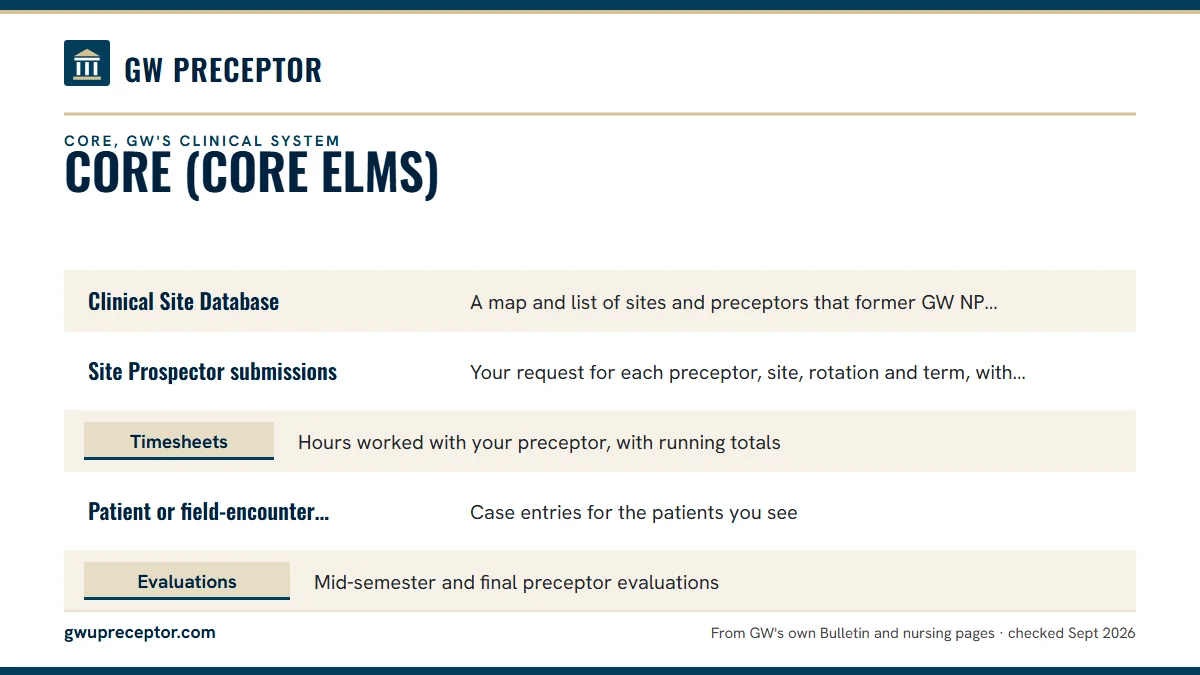
GW's 2021 clinical placement guide lists CORE's main areas as the Clinical Site Database, Clinical Placement Requests, Timesheets, Patient Data Logs and Evaluations. The 2026 workshop uses newer names for some of them, such as Site Prospector Submission and field encounters.
| Area | What it holds | When you use it |
|---|---|---|
| Clinical Site Database | A map and list of sites and preceptors that former GW NP students used | While you search for a preceptor |
| Site Prospector submissions | Your request for each preceptor, site, rotation and term, with license and bio or CV attached | As soon as a preceptor agrees |
| Timesheets | Hours worked with your preceptor, with running totals | After each shift, or at least weekly |
| Patient or field-encounter logs | Case entries for the patients you see | Alongside each timesheet |
| Evaluations | Mid-semester and final preceptor evaluations | At midterm and at the end of each term |
| Document Library and uploads | Term deadlines and other posted documents; the signed last page of the preceptor guide | Before each term and before your first shift |
Requests: the Site Prospector
Your clinical request lives in CORE as a Site Prospector submission. Each one covers a single preceptor at a single site for a single rotation and term, so a student with two preceptors in one course files two. The preceptor's license and bio or CV go in as attachments, along with the right emails for evaluations and for the site's agreement contact.
After you submit, the request passes through five review stages in a set order, starting with the program director and ending with the site's own onboarding. The Site Prospector guide covers what to enter and the slips that hold a request up.
Timesheets and encounter logs
GW's 2026 CORE workshop gives three logging rules. Document after each shift, if not weekly, and enter total hours. Log at least one patient, called a field encounter or case log, for every hour. Complete every clinical hour within the semester dates.
GW's 2021 clinical placement guide called these records Timesheets and Patient Data Logs and set patient targets for some courses, such as about 110 patients in the first AGPCNP course. Targets live in your current course, so check the syllabus and your Clinical Experience Faculty rather than relying on an older figure. The hour log guide goes into the detail.
Entering each shift while it is fresh keeps your hours and encounters consistent with each other, and it makes the one-patient-per-hour rule easy to show instead of something to reconstruct from memory at the end of the term.
Evaluations and the Document Library
Preceptor evaluations also run through CORE. According to GW's 2021 guide, CORE emails the midterm and end-of-term forms to the preceptor, who reviews them with you before submitting; the results then appear in CORE. That is why the Site Prospector asks for a correct preceptor email: the form goes wherever that address points. The evaluations guide covers faculty site visits as well.
The Document Library is CORE's reference shelf. GW's 2026 workshop says clinical request deadlines are posted there, which makes it the tiebreaker when GW's website and other materials give different dates. The preceptor guide sign-off ends in CORE too: your preceptor signs the guide's last page and you upload it.
Check each preceptor email twice before you submit. A typo sends the evaluation to the wrong inbox and holds up your course record.
How we set you up for CORE
CORE rewards students who arrive with everything in hand, and that is how our placements arrive. When we match you with a preceptor, you receive the details the Site Prospector asks for: a copy of the clinician's license, a current bio or CV, a confirmed evaluation email, and the name and email of the person at the site who handles the affiliation agreement.
We also check the match against your course before you file, so the setting and the preceptor's background line up with what the program director reviews. You enter the request under your own CORE account with the content ready to go, and if anything changes mid-term, we are on call for the replacement. Read how we work, then send your course and term through the form below.
Questions GW students ask
What does ELMS mean in CORE ELMS?
Experiential Learning Management System. GW's 2026 CLASI workshop deck identifies CORE as CORE Higher Education Group's experiential learning product. At GW Nursing it holds graduate students' clinical requests, hour and encounter logs, preceptor evaluations and clinical documents in one place, from the first request to the final evaluation.
How do certificate students who start clinicals right away get CORE access?
Email the Clinical Placement Team and ask for access. GW's standard timing ties CORE to NURS 6222, and a first-semester clinical course can come before that point, which is common for post-master's certificate students. Ask early, because you need CORE to file your first Site Prospector submission.
Can I see in CORE which preceptors past GW students used?
Yes. CORE's Clinical Site Database shows sites and preceptors that former GW NP students worked with, on a map and in a list. Treat it as a list of leads, since a listed clinician still has to agree to take you this term. The site database guide explains how to use it well.
How often should I enter hours in CORE?
GW's 2026 CORE workshop says to document after each shift, or at least weekly, entering total hours each time. Each hour needs at least one patient logged, and all hours must fall inside the semester dates. Hours logged outside the term, or before your clearance, do not count toward the course.
Where do I find my term's clinical request deadline?
In CORE's Document Library. GW's 2026 workshop says clinical request deadlines are posted there, and it is the best tiebreaker when the website's dates differ from the workshop's. Where the two still conflict for your term, the Clinical Placement Team can settle it. The deadline guide lists every date GW has published.
Related pages
Last checked 2026-09-24
We check these pages against GW's Bulletin and GW Nursing's own program and clinical pages. Your course, CORE and GW's Clinical Placement Team have the final word.
GW asks you to find your own site and preceptor. Hand that search to us.
Tell us your GW program, where you live and which clinical course is next. We find preceptors who fit the course and prepare the license, bio and site details GW's review asks for, so your Site Prospector goes in complete.
- Preceptors matched to the course: family practice for
NURS 6230toNURS 6232, older-adult primary care for AGPCNP, psychiatric care for PMHNP - License, bio or CV and the site's agreement signatory ready for your CORE submission
- Close to home, in DC, Maryland, Virginia or wherever you live and hold your RN license
Start your placement plan
Your program, city and next clinical term is all we need to begin.