Behind on clinical hours in a GW course
Work out the exact gap today, then add shifts or a second cleared preceptor while weeks remain. GW counts only hours that fall inside your semester dates and are logged in CORE with at least one patient per hour, so catching up means more capacity this term, not a later finish.
Get your placement plan
Tell us your GW program and where you live. A placement advisor replies with the preceptor and site options that fit your GW course.
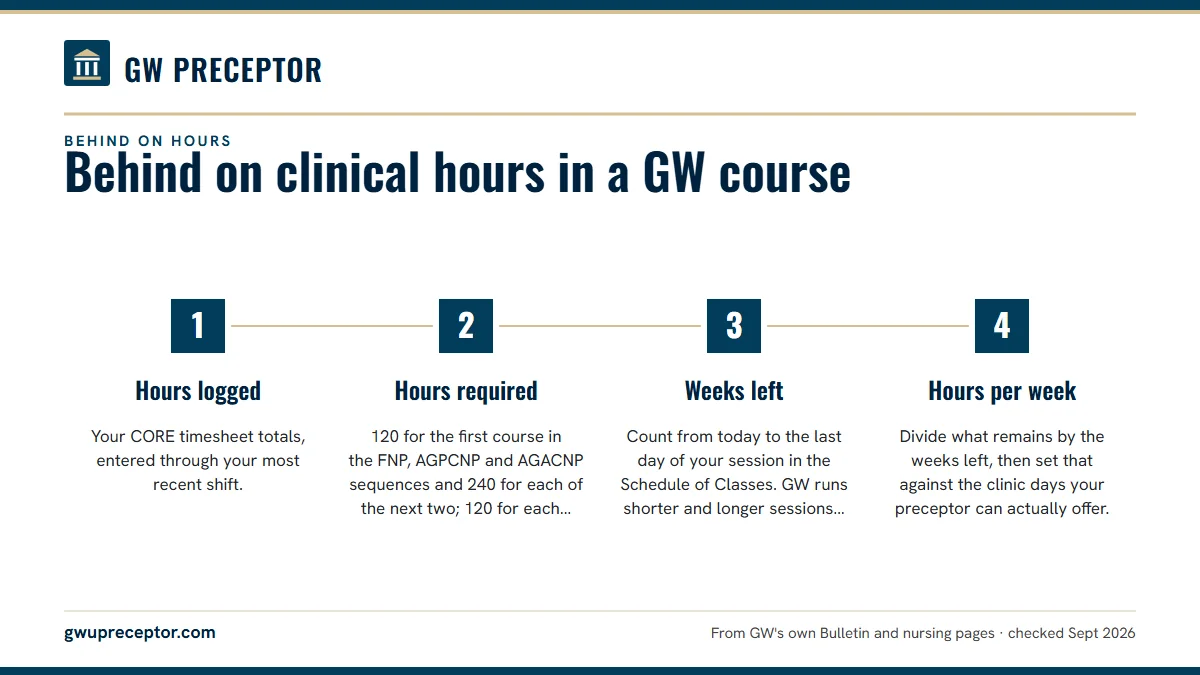
Measure the gap before anything else
Worry makes a shortfall feel larger than it is. Pull four numbers and the plan usually becomes obvious.
- Hours loggedYour CORE timesheet totals, entered through your most recent shift.
- Hours required120 for the first course in the FNP, AGPCNP and AGACNP sequences and 240 for each of the next two; 120 for each PMHNP clinical course; 150 for each leadership practicum.
- Weeks leftCount from today to the last day of your session in the Schedule of Classes. GW runs shorter and longer sessions in the same term, so use your own course's dates.
- Hours per weekDivide what remains by the weeks left, then set that against the clinic days your preceptor can actually offer.
| Hours still needed | Weeks left | Hours per week |
|---|---|---|
| 160 | 10 | 16 |
| 160 | 7 | About 23 |
| 200 | 6 | About 33 |
A load like the last row often outgrows one preceptor's schedule. That is the point to add capacity rather than hope a few long days will close it.
The rules that decide which hours count
Before adding a single shift, make sure the hours you already have will stand. GW's 2026 CORE workshop deck sets the logging rules.
- Every clinical hour must fall inside the semester dates.
- Log after each shift, or weekly at the latest, and enter your total hours.
- Record at least one patient, logged as a field encounter, for every hour.
- Nothing counts before the term that follows your clearance notice is underway.
- Per GW's 2021 clinical placement guide, time spent without the right license, or while your clearance is revoked, earns no credit.
Encounters can fall short even when hours look fine. For the first AGPCNP course, GW's 2021 guide named 110 patients, roughly six per eight-hour day; ask whether your course carries a target like that. If your logs are behind rather than your hours, fix that first, using the hour logs page.
Adding a second preceptor
The most direct way to add hours is a second preceptor working alongside the first. CORE is built for it: every preceptor at every site gets a separate Site Prospector submission, so a second clinician means a second submission with their license and bio or CV attached.
Before that second clinician sees a patient with you, the Clinical Placement Team has to vet them, per GW's 2021 guide, and your hours together begin with clearance. A second clinician at your current practice may fall under an agreement GW already holds; a new site needs its own agreement, which takes longer.
Neither a cap on preceptors per course nor a weekly hour ceiling appears in GW's public rules. Ask your Clinical Experience Faculty what is workable for your course before committing to a heavy schedule.
Talk to your Clinical Experience Faculty early
Your CEF supervises your clinical work this term and judges whether sites and preceptors are appropriate. Bring the gap to them while it is still a scheduling problem; a CEF who hears about it in week five has far more room to help than one who hears in the final month. Put your four numbers in an email so the plan you agree on is in writing.
GW's 2021 guide also marks mid-semester as a decision point for students without a working site, when the CEF and program director look at whether the course is still achievable this term. Your mid-semester preceptor evaluation arrives around the same time, so a clear plan for the remaining hours strengthens both conversations. The evaluations page explains how those evaluations work.
If the hours will not fit this term
Sometimes the math does not close. GW's rules then offer two formal routes, each with conditions, and your faculty and program director are the people to decide with.
- Incomplete: an instructor may record an "I" when your earlier work is satisfactory and the shortfall comes from reasons beyond your control. The remaining work then has a completion window of up to one calendar year.
- Withdrawal: once the add and drop weeks pass, leaving a course needs permission from the program director and the associate dean, and a W appears on your transcript.
Either route can shift the courses that follow. Dates and details are on the semester calendar and incompletes page, and the delayed graduation page shows how one slipped course can move your conferral date. If the shortfall started with a preceptor leaving, see preceptor dropped out.
How we add capacity
When the gap needs another preceptor, we find one who fits your course and can give you the extra clinic days before the term ends. Your placement advisor checks availability against your remaining hours and weeks, not just a general yes, and gathers the license details, bio or CV and site signatory contact for your second Site Prospector submission.
We look first at clinicians at your current site and at nearby sites that have hosted GW students, since those can clear faster, and keep a backup ready in case the first option stalls. GW's Clinical Placement Team verifies and clears the new preceptor; we make sure what they receive is complete the first time. Send your course, hours logged and session end date with the form below.
Questions GW students ask
Can I finish my clinical hours after the semester ends?
Not as ordinary clinical hours. GW's 2026 CORE workshop deck says all clinical hours must fall within the semester dates. If you cannot finish in time, the options are formal ones, such as an incomplete granted at your instructor's discretion, and you should raise them with your faculty and program director as early as possible.
Is there a maximum number of clinical hours per week at GW?
No weekly ceiling appears in GW's published rules. What limits you in practice is your preceptor's clinic schedule, the site's own rules and your job; GW's DNP FNP page strongly recommends not working full-time. Ask your Clinical Experience Faculty what schedule suits your course before planning a run of long weeks.
How many preceptors can I have in one GW course?
GW's public rules set no number. CORE is set up for more than one, since each preceptor at each site gets a separate Site Prospector submission, and GW's 2021 guide allows adding a preceptor once the Clinical Placement Team verifies them. Your CEF can tell you what works for your course objectives.
Do patient encounters matter as much as hours?
Both are logged in CORE. GW's 2026 deck asks for at least one patient per logged hour, and the 2021 guide gave some courses patient totals to reach. A quiet clinic can leave your encounter count trailing while your hours look healthy, so check both totals every week.
Will falling behind affect my grade?
It can. GW graduate courses need a B or better, and the course's hours are part of what you must complete. The earlier your Clinical Experience Faculty hears about the gap, the more room there is to add a preceptor or extra shifts; a late fix usually leaves fewer choices.
Related pages
Last checked 2026-09-24
We check these pages against GW's Bulletin and GW Nursing's own program and clinical pages. Your course, CORE and GW's Clinical Placement Team have the final word.
GW asks you to find your own site and preceptor. Hand that search to us.
Tell us your GW program, where you live and which clinical course is next. We find preceptors who fit the course and prepare the license, bio and site details GW's review asks for, so your Site Prospector goes in complete.
- Preceptors matched to the course: family practice for
NURS 6230toNURS 6232, older-adult primary care for AGPCNP, psychiatric care for PMHNP - License, bio or CV and the site's agreement signatory ready for your CORE submission
- Close to home, in DC, Maryland, Virginia or wherever you live and hold your RN license
Start your placement plan
Your program, city and next clinical term is all we need to begin.