GW's Clinical Placement Model, one step at a time
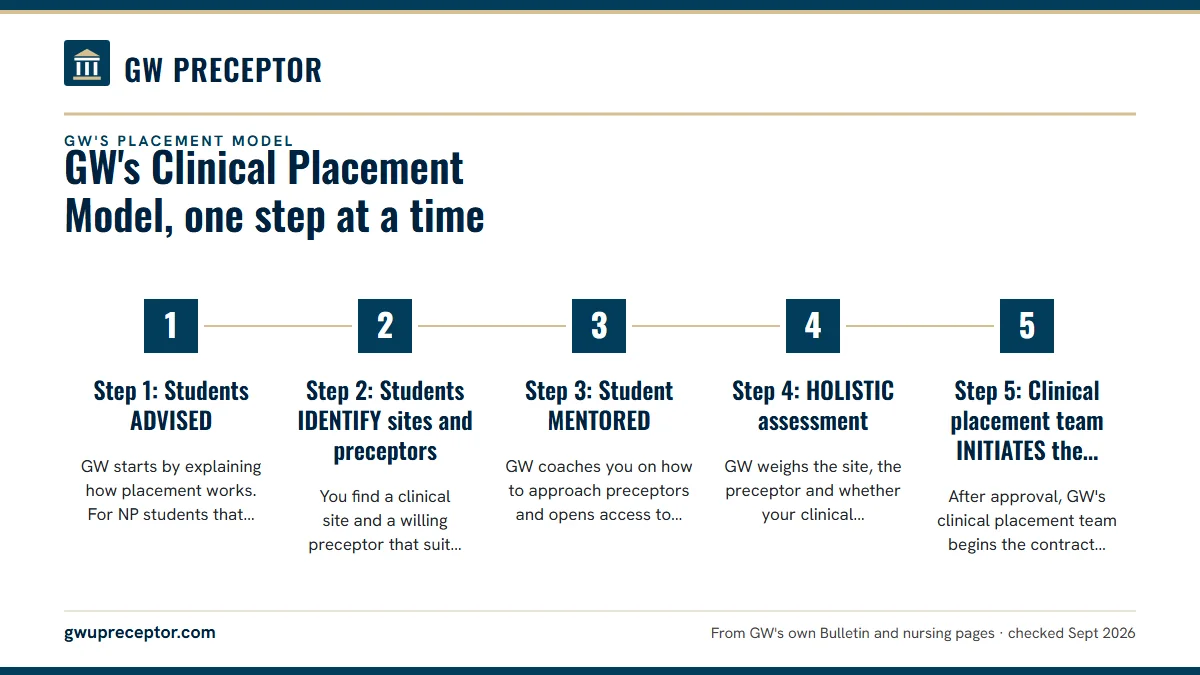
GW Nursing frames graduate placement as a five-step model that begins with your request for a preferred site. You are advised, you identify a site and preceptor, you are mentored on approaching them, GW makes a holistic assessment, and the clinical placement team then opens the contract. When a preceptor declines or is not approved, the model loops you back to step 2 with ongoing support.
Get your placement plan
Tell us your GW program and where you live. A placement advisor replies with the preceptor and site options that fit your GW course.
A model that starts with your request
GW's Clinical Placement Model page says the process is "driven by student submission of a request for placement in a preferred clinical site." That single line explains the design. GW responds to a site you bring forward rather than handing you one from a list, and the wording is the same in GW's 2019 and 2026 versions of the page.
The page ties the model to CCNE Standard III, and GW also posts the same flow as a one-page graphic on its Box account. GW writes the key word of each step in capitals, ADVISED, IDENTIFY, MENTORED, HOLISTIC and INITIATES, which makes the model easy to remember and easy to misread. Only one of those capital words describes work that produces a preceptor, and it is yours.
The five steps as GW writes them
- Step 1: Students ADVISEDGW starts by explaining how placement works. For NP students that advice comes early: a clinical webinar invitation during
NURS 6220, CORE access beforeNURS 6222, and a CORE workshop during CLASI. - Step 2: Students IDENTIFY sites and preceptorsYou find a clinical site and a willing preceptor that suit your course. Everything after this step waits on it.
- Step 3: Student MENTOREDGW coaches you on how to approach preceptors and opens access to networking opportunities.
- Step 4: HOLISTIC assessmentGW weighs the site, the preceptor and whether your clinical objectives can be met in that setting.
- Step 5: Clinical placement team INITIATES the contractAfter approval, GW's clinical placement team begins the contract process with the site. Your pre-clinical requirements must be met first.
Under the five steps, GW's page adds a loop for the hard case: if a preceptor is not willing or available, or is not approved, the student receives "Ongoing INTERVENTION and support" and returns to step 2.
What each step asks of you in practice
GW's page names the steps but says little about the student's side of each. Set against GW's other published guidance, the division of labor looks like this.
| Step | Your part | GW's part |
|---|---|---|
| ADVISED | Attend the clinical webinar, read CORE's Document Library, learn your course's hours and expected setting | Orientation, the webinar invitation, CORE access and the CLASI CORE workshop |
| IDENTIFY | Build a target list, contact offices, win a firm yes, collect the preceptor's license and bio or CV | A list of sites earlier students used in your state, on request, plus the CORE site database |
| MENTORED | Ask for feedback on your approach and follow every networking lead | Guidance on approaching preceptors and access to networking |
| HOLISTIC | File the Site Prospector submission in CORE and answer faculty questions quickly | Program director and faculty review of the preceptor, the setting and the course fit |
| INITIATES | Keep Complio complete and stay in touch with the site | The Clinical Placement Team's contract work, then compliance review and clearance |
Read across the rows and the balance is plain. GW explains, lists, coaches and reviews, while the step that actually produces a preceptor sits with the student.
Step 2 decides your start date
Every other step has a GW office behind it. Step 2 has you, and it is where most delays begin. Outside the Acute Care tracks, GW puts the site and preceptor search on the graduate student, and the own-preceptor guide walks through what that looks like program by program.
A finished step 2 is more than a name and a phone call. It is a clinician whose credentials pass GW's rules, a setting that suits the course, someone at the site with authority to sign the affiliation agreement, and working emails for evaluations. Reaching step 4 with any of those missing sends the request back for more information, or back to step 2 altogether.
The list GW shares of previously used sites is a starting point for step 2 rather than a finish line. Students report that clinicians on it may not be taking students in a given term, so the clinical site database works best as a list of leads to call.
Step 4: what the holistic assessment weighs
GW's Become a Preceptor page describes three things faculty balance when they pair a student with a preceptor: the clinician's own qualifications, what the setting does well, and what this student and this course need. That balance is the holistic assessment, and in CORE it happens at the Program Director Review stage.
On the preceptor side, GW's 2021 clinical placement guide wants an MD, DO, NP or CNM with two-plus years of advanced practice behind them and a clean, active license. On the setting side, the answer depends on the course; that guide pointed the first FNP course toward internal medicine and the second toward OB/GYN and pediatrics. Current rules may differ, so confirm yours in the course.
GW's plans of study add a reminder worth keeping: the program director signs off on preceptor and site details ahead of time, and some regions come with restrictions of their own.
The loop: ongoing intervention and support
GW's page plans for the common setback. When a preceptor says no, drops out of contact or is not approved, the model's answer is ongoing intervention and support, followed by a return to step 2.
What GW publishes as that support
- A roster of sites and preceptors GW students have used before in your state, which the Clinical Placement Team sends when asked
- The Clinical Site Database in CORE, described in GW's 2021 guide as a resource guide
- Mentoring on how to approach preceptors, and access to networking
- Help from the program director or faculty in weighing alternatives, per GW's 2021 guide
- A clinical placement webinar for NP students, listed on GW's events dashboard as waiting to be rescheduled
Each pass through the loop costs time, since every replacement preceptor starts over in CORE with its own submission and review. Keep the request deadlines in view while you loop.
The loop has no published limit, but the calendar sets one: under GW's 2021 guide, reaching the middle of the term unplaced triggers a meeting with your faculty and program director.
Where we fit in GW's model
We take on steps 2 and 3, the two steps that decide when you start. Our placement desk searches for a preceptor and a site that match your GW course, in person in your area, and handles the outreach, the follow-up and the pitch that win a clinician's yes.
We also get you ready for step 4. By the time you file in CORE, you hold the clinician's license and a bio or CV, the site's signatory and agreement contact, and a clear match between setting and course. If a preceptor later declines or drops, we are already working the loop, so the replacement search starts the same day.
The approval at step 4 and the contract at step 5 stay with GW. What we shape is the quality of what GW receives, and we hold that to a high standard. Our process for GW students is laid out step by step, and the form below reaches the placement desk directly.
Questions GW students ask
Does GW assign preceptors under its Clinical Placement Model?
For most graduate programs, the model responds to a site the student proposes rather than assigning one. The Acute Care tracks work differently, with the program director closely involved and sites limited to DC, Maryland and Northern Virginia. GW also handles placement itself for its campus-based pre-licensure students in Ashburn.
Who mentors GW students in step 3?
GW's model page does not name a role. In practice your contacts are the Clinical Placement Team, your program director and, once a clinical course is running, the faculty member GW assigns to supervise you that term. The roles guide sets out who handles which part of placement.
How many times can I return to step 2?
GW publishes no cap. The real limit is time: each replacement means another CORE entry and review, request deadlines fall months before the term, and GW's 2021 guide treats a student unplaced at midterm as a case for a talk about finishing the course at all.
Does the model apply to nurse-midwifery students?
The same request path through CORE applies. GW's midwifery page says its faculty and placement staff help midwifery students land local sites, drawing on a network of midwives in the Washington area and nationwide that leans toward birth centers and home birth practice.
What happens after step 5?
Once the contract is in place, GW reviews your compliance items, the site completes any onboarding, and the Clinical Placement Team sends a clearance notification. Countable hours follow once the next term opens. The placement process guide follows the full route to your first shift.
Related pages
Last checked 2026-09-24
We check these pages against GW's Bulletin and GW Nursing's own program and clinical pages. Your course, CORE and GW's Clinical Placement Team have the final word.
GW asks you to find your own site and preceptor. Hand that search to us.
Tell us your GW program, where you live and which clinical course is next. We find preceptors who fit the course and prepare the license, bio and site details GW's review asks for, so your Site Prospector goes in complete.
- Preceptors matched to the course: family practice for
NURS 6230toNURS 6232, older-adult primary care for AGPCNP, psychiatric care for PMHNP - License, bio or CV and the site's agreement signatory ready for your CORE submission
- Close to home, in DC, Maryland, Virginia or wherever you live and hold your RN license
Start your placement plan
Your program, city and next clinical term is all we need to begin.